School Transport & Bus Safety in Qatar: Parent Guide
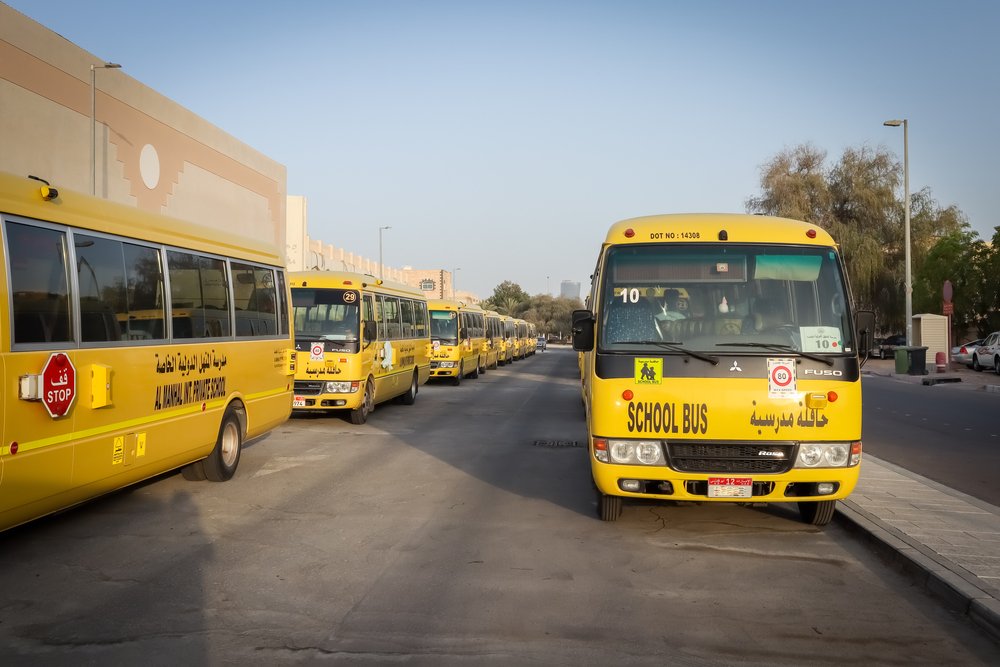
If your child travels by school bus in Qatar, begin with four basic checks: confirm that your child has an assigned seat with a working seatbelt, that a trained bus supervisor is present in addition to the driver, that attendance is recorded at boarding and drop-off, and that the bus is checked after every route to make sure no child remains inside.
These requirements matter particularly in Qatar’s climate, where leaving a child unattended inside a parked vehicle can quickly become a life-threatening emergency.
Current school-transport policies citing Ministry of Education and Higher Education guidance require designated seating, seatbelt use, trained supervisors, air-conditioned buses, first-aid kits, attendance records and procedures for communicating with parents when buses are delayed or arrive early.
This guide explains how school transport works in Qatar, what safety standards parents should expect, current 2026–27 fee examples and the questions to ask before registering.
School transport in Qatar
School transport is widely used by families living across Doha, Al Wakra, Lusail, Al Rayyan and other municipalities.
Private schools commonly offer transport as an optional paid service. A school may:
- Operate its own fleet;
- Lease buses and employ the transport staff itself; or
- Contract a specialist transport provider.
Private schools and kindergartens operate under Ministry of Education and Higher Education oversight and must develop safety and operating policies consistent with Ministry requirements.
Parents should not assume that every school offers transport to every neighbourhood. A place is normally subject to:
- Route availability;
- Seat capacity;
- The child’s address;
- Journey time;
- Road access; and
- Registration before the school’s transport deadline.
The quick answer for busy parents
Before registering your child, confirm the following.
An assigned seat and working seatbelt
Each child should have their own designated seat.
Current Ministry guidance reproduced in school transport policies requires a designated place for every student and emphasises that students must use their seatbelts while seated on the bus.
Ask the school:
- Does every assigned seat have a functioning belt?
- Who checks that children remain buckled?
- What happens if a belt is damaged?
- Are children ever allowed to share seats?
Overcrowding, standing in the aisle or sharing a seat should be treated as serious safety concerns.
A bus supervisor in addition to the driver
A trained bus attendant, monitor or guardian should be present inside the bus.
The Ministry guidance quoted in ISL Qatar’s current transport policy states that supervisors inside school buses are mandatory to monitor students and assist them when boarding and getting off.
The supervisor’s responsibilities may include:
- Recording attendance;
- Helping children board and leave safely;
- Enforcing seatbelt use;
- Keeping the aisle and emergency exit clear;
- Maintaining order;
- Monitoring medical or behavioural concerns;
- Handing younger children to an authorised adult; and
- Checking the bus after the final drop-off.
The driver should concentrate on driving rather than simultaneously supervising students.
A properly licensed and trained driver
Drivers should hold the correct valid Qatar vocational driving licence for the vehicle being operated.
Current private-school transport information shows schools requiring uniformed drivers with appropriate vocational licences, insurance cover and regular safety training.
Ask the school or provider how it checks:
- Driving-licence validity;
- Professional training;
- Medical fitness;
- Traffic violations;
- Familiarity with the route;
- Emergency procedures; and
- Refresher training.
The original claim that every driver must have a formally certified “clean record” is not clearly supported by the public guidance reviewed. The better question is what screening and ongoing performance checks the school applies.
A safe pickup and handover procedure
The route should have fixed or clearly communicated collection and drop-off points.
For younger children, the school should explain whether a parent or named adult must be present. ISL Qatar’s current rules, for example, state that young children will not be left at the stop if no adult is there to collect them. The family is contacted and an alternative handover point is arranged.
Do not assume that this exact procedure applies at every school. Obtain your own school’s rule in writing.
Working air-conditioning
The Ministry’s school-bus guidance requires buses to be clean, in good condition and air-conditioned.
Parents should report weak or failed air-conditioning immediately, particularly during warmer months.
A post-route bus check
The bus should be physically inspected after children leave.
A strong procedure uses more than one check. ISL Qatar, for example, describes a three-stage process involving the bus monitor, driver and school security guard after the morning route. GEMS American Academy Qatar says its buses are checked daily by two teams to prevent a child being left behind.
Ask who signs off the final check and how the school records that it has been completed.
How school transport works in Qatar
Private-school transport
Many private schools offer transport as an optional service, but registration does not guarantee a place.
The school or its contractor typically creates routes after reviewing:
- The number of registered students;
- Home locations;
- Available vehicles;
- School starting and finishing times; and
- Reasonable route groupings.
Some schools provide door-to-door pickup, while others use common stops. Families living inside compounds or towers may be asked to meet the bus at the main gate or another accessible location.
School-operated buses versus outsourced providers
School-operated fleet
The school owns, leases or directly manages the vehicles and transport staff.
Possible advantages include:
- One main contact;
- Greater direct control by school management;
- Easier coordination with attendance and safeguarding teams; and
- Direct accountability for routes and staff.
Even with an in-house fleet, ask who holds responsibility for vehicle maintenance, inspections and driver training.
Outsourced transport company
A private transport company provides the vehicles, drivers and supervisors under contract with the school.
This is common in Qatar. GEMS American Academy Qatar currently uses School Transport Services, while ISL Qatar uses Al Mana Leasing for its 2026–27 service.
Ask:
- What is the provider’s legal name?
- Is the company properly licensed and insured?
- Does the school audit the contractor?
- Who investigates complaints?
- Who can suspend a driver or supervisor?
- Who is responsible for communicating delays?
- Is the transport fee paid to the school or provider?
Outsourcing does not remove the school’s responsibility to protect its students and monitor the service it offers families.
Private driver, carpool or nanny drop-off
Families may arrange their own school transportation rather than use the official bus.
The driver must hold a valid licence and the vehicle must be registered and insured. Qatar’s Traffic Law requires the driver and front passenger to wear seatbelts, while MOI safety guidance states that children under ten should not sit in the front seat.
For safer private transport:
- Give each child a separate seat and belt;
- Keep children under ten out of the front seat;
- Use a child restraint appropriate to the child’s age, height and weight;
- Never place more passengers in the vehicle than it is designed to carry;
- Confirm who is authorised to collect the child;
- Do not leave a child unattended in a parked vehicle; and
- Avoid informal paid carpool services whose licensing or insurance status cannot be confirmed.
The same driver should not be expected to supervise several young or high-support-needs children while driving.
Typical school bus costs in Qatar
There is no standard Qatar-wide private-school transport fee.
Charges vary according to:
- School;
- Distance or residential zone;
- One-way or return service;
- Number of school terms;
- Transport provider;
- Route demand; and
- Whether the service is door-to-door or uses common stops.
Current published 2026–27 examples include the following.
GEMS American Academy Qatar
Annual return transport:
- Al Wakrah: QAR 4,310;
- Doha: QAR 7,530; and
- Lusail: QAR 9,150.
Annual one-way transport:
- Al Wakrah: QAR 3,440;
- Doha: QAR 6,030; and
- Lusail: QAR 7,320.
International School of London Qatar
For 2026–27:
- Return service: QAR 8,400
- One-way service: QAR 6,200
Based on these current published examples, a more defensible planning range for private-school transport is:
Approximately QAR 4,300–9,200 a year for return transport, with one-way services in current examples ranging from approximately QAR 3,400–7,300.
This is not an official market average. Some schools may charge below or above the range.
Before registering, confirm:
- Whether the price is one-way or return;
- Whether the fee changes by area;
- Whether it is annual, termly or monthly;
- Payment dates;
- Whether the fee is paid to the school or contractor;
- Late-payment charges;
- Whether siblings receive a discount;
- Whether the price changes after moving home;
- Refund and cancellation terms; and
- Whether service begins on the first school day.
Refund policies can be strict. ISL Qatar’s current terms state that paid bus fees are non-refundable and cannot be transferred to another person. Other schools may have different rules.
The safety rules every school bus should follow
A safe bus is not defined only by its colour, logo or appearance.
The operating system around the vehicle matters just as much.
Seatbelts, seating and bus attendants
Parents should expect:
- One designated seat
- A usable seatbelt for the assigned seat;
- No standing or sharing seats;
- A clear and unobstructed aisle;
- Accessible emergency exits;
- A supervisor in addition to the driver;
- Attendance records for pickup and drop-off; and
- Support arrangements for students with disabilities.
The Ministry guidance reproduced in current school policy specifically requires assigned seating, seatbelt use, passenger registers, supervisors and support requirements for students with disabilities.
Ask how the school handles a child who repeatedly removes their belt or moves around while the bus is travelling.
Headcounts and no-child-left-behind checks
A proper system should identify:
- Who boarded;
- Who left at school;
- Who boarded for the afternoon route;
- Who was handed over at each stop; and
- Whether the bus was empty after the route.
A verbal headcount alone is weaker than a recorded attendance system combined with a physical walk-through.
Electronic attendance technology can strengthen the process, but it does not replace the driver’s and attendant’s visual inspection.
GEMS American Academy Qatar says its buses use electronic attendance systems and undergo daily checks to ensure that no child remains on board.
Driver checks and conduct
Drivers should:
- Hold the correct vocational licence;
- Follow the approved route;
- Observe speed limits;
- Avoid mobile-phone use and distracting conversations;
- Stop in safe locations;
- Avoid moving until boarding or disembarking is complete; and
- Treat students and staff appropriately.
Current school policies also require drivers to understand the pickup and drop-off locations and prohibit phone or side conversations while driving.
Parents should report:
- Speeding;
- Harsh braking;
- Phone use;
- Unsafe overtaking;
- Dropping children on the wrong side of the road;
- Leaving the vehicle unattended while children are inside; or
- Deviating from the route without explanation.
Record the date, time, bus number and location.
Vehicle condition and emergency equipment
The bus should have:
- Effective air-conditioning;
- Safe doors and steps;
- Unobstructed emergency exits;
- A stocked first-aid kit;
- Suitable fire-safety equipment;
- Maintained tyres and lights;
- Clean seating;
- Valid registration and insurance; and
- Appropriate accessibility equipment where required.
The Ministry’s guidance specifically calls for clean, air-conditioned buses, regularly updated first-aid kits and necessary support for students with disabilities.
Vehicle registration, licensing and compliance with technical safety requirements fall under the General Directorate of Traffic’s Licensing Affairs Department.
First-aid and medical needs
Bus supervisors should have appropriate first-aid awareness.
The Ministry guidance includes training supervisors to respond to health incidents such as abnormal blood-sugar levels, epilepsy and heart emergencies.
Tell the school in writing if your child has:
- Asthma;
- Severe allergies;
- Epilepsy;
- Diabetes;
- Mobility needs;
- A communication difficulty;
- A behavioural support plan; or
- Emergency medication.
Ask who is permitted to administer medication and whether it may be carried on the bus.
Do not assume that the driver or attendant is authorised to administer prescription medicine without a documented school procedure.
GPS, CCTV and parent tracking
GPS tracking, cameras and electronic attendance can improve oversight, but they are not publicly listed as universal requirements for every Qatar school bus.
Current examples include:
- GEMS American Academy Qatar: GPS monitoring, surveillance cameras and electronic attendance;
- ISL Qatar: central GPS monitoring of timing and speed.
Ask whether the system provides:
- Live parent tracking;
- Arrival notifications;
- Delay alerts;
- Route history;
- Speed monitoring;
- Student boarding notifications; and
- CCTV incident review.
Also ask how the school protects student privacy and who can access recordings or location data.
Safe pickup and drop-off habits
MOI guidance tells children to board or leave only after the vehicle has stopped completely, avoid playing near the bus and remain far enough away to be visible to the driver.
Families should build the following habits.
Be ready before the bus arrives
Stand at the agreed safe location before the scheduled time.
Schools may instruct drivers to wait only briefly. ISL Qatar’s current service allows no more than two minutes for a home pickup before the bus continues.
Wait away from the road
Children should wait on the pavement, inside the compound entrance or another protected area.
They should approach only after the bus has stopped and the supervisor signals that it is safe.
Never cross directly in front of or behind the bus
The area immediately around a large vehicle contains blind spots.
A child should not:
- Bend near the wheels;
- Chase the bus;
- Return for a dropped item;
- Walk behind it; or
- Cross until the driver or supervising adult has confirmed it is safe.
Use an agreed handover person
Give the school a current list of adults authorised to collect younger children.
Explain how changes are communicated and whether identification is required.
Keep contact details current
Notify the school promptly after changing:
- Phone number;
- Home address;
- Emergency contact;
- Authorised collector; or
- Medical information.
A change of address may place the family on a different route and does not guarantee continued seat availability.
Questions to ask your school before you sign up
Before paying, ask:
- Is a trained supervisor present on every route?
- Does every assigned seat have a working seatbelt?
- How is attendance recorded at pickup and drop-off?
- Who checks the bus after the route?
- Are drivers vocationally licensed and regularly assessed?
- Who owns and operates the buses?
- Are the buses comprehensively insured, including passengers?
- Is GPS, CCTV or electronic attendance available?
- How are delays communicated?
- What is the estimated pickup time and total journey time?
- Is there a maximum route duration set by the school?
- What happens when no authorised adult is present?
- How does the bus support allergies, asthma or disabilities?
- Are first-aid-trained staff present?
- Who handles complaints?
- What is the refund policy?
- Can a child use one-way transport?
- Does moving home affect the route or fee?
There is no publicly stated universal maximum bus journey time applying to all schools. Ask for the expected duration for your child’s specific route rather than accepting a general promise.
What to teach your child about bus safety
Give children simple rules they can remember:
- Wear the seatbelt for the whole journey.
- Remain seated while the bus is moving.
- Keep bags and feet out of the aisle.
- Listen to the supervisor.
- Do not distract the driver.
- Wait for the bus to stop before standing.
- Never push while boarding or leaving.
- Tell an adult if you feel sick or unsafe.
- Do not get off at a different stop.
- Do not leave with an unfamiliar adult.
- Never return beneath or beside the bus for a dropped item.
- Make noise and alert the driver if you are accidentally left inside.
Older children should know a parent’s phone number and the school’s name.
What happens if no one is at the stop?
The school should have a documented procedure.
A responsible service should not leave a young child alone at an empty stop. Depending on the provider, the bus may:
- Keep the child onboard while the parent is contacted;
- Arrange a later meeting point;
- Complete the remaining route first;
- Return the child to school; or
- Hand the child to an approved school employee.
ISL Qatar’s current policy states that young children are not dropped off without an adult present and that parents are contacted to arrange collection at another point.
The exact age threshold and procedure differ by school. Confirm both before signing the transport contract.
What to do if you have a complaint
Raise it with the transport office
Report the issue in writing and include:
- Child’s name;
- Bus and route number;
- Date and time;
- Location;
- Driver or supervisor name, if known;
- Clear description;
- Photographs or screenshots where appropriate; and
- The action you want the school to take.
Keep the complaint reference or email trail.
Escalate to school leadership
If the transport office does not respond, escalate to the principal, head of school or safeguarding lead.
For outsourced services, copy both the school and transport company.
Submit a private-school complaint to MOEHE
The Ministry operates an online complaints system through the Qatar Private Schools Portal.
The portal asks parents to provide complete information and supporting documents. It states that complaints are processed within three working days, although a complex investigation may take longer.
MOEHE contact channels include:
- Call centre: 155;
- Main telephone: +974 4404 4444;
- Private Education Affairs email: psa@edu.gov.qa.
Report road-safety concerns
For a traffic or licensing issue, the General Directorate of Traffic publishes the following contacts:
- 2344444;
- +974 4487 2624;
- traffic@moi.gov.qa.
Call 999 where there is an immediate emergency, dangerous driving in progress, an accident, a missing child or an urgent threat to safety.
FAQs
Are seatbelts required on school buses in Qatar?
Ministry school-bus guidance requires designated seating and emphasises seatbelt use while students are sitting on the bus.
Parents should confirm that their child’s assigned seat has a functioning belt and that the supervisor enforces its use.
Should there be an adult supervisor on the bus?
Yes.
The Ministry guidance cited in current school transport policies states that supervisors inside buses are mandatory to monitor students and help them board and leave safely.
How much does private-school transport cost?
Current published 2026–27 examples range from approximately QAR 4,310 to QAR 9,150 a year for return transport.
One-way examples range from approximately QAR 3,440 to QAR 7,320. The price depends on the school and residential zone.
Is school transport refundable?
Not always.
Refund terms are set by the school or contractor. Some providers state that fees are non-refundable even if the family cancels. Read the transport contract before paying.
Is GPS tracking mandatory?
The public guidance reviewed does not establish GPS as a universal requirement for every school bus.
Several schools and providers use GPS, electronic attendance and cameras as additional safety systems. Ask what your school provides.
What happens if no one collects my child?
The school should have a written no-handover procedure.
A young child should not be left alone. The provider may keep the child on the bus, contact the parents and arrange collection later or return the child to school. Confirm the exact rule and age threshold with your school.
Can I arrange a private driver or carpool?
Yes, but confirm that the driver is licensed and the vehicle is registered and insured.
Each child should have their own seat and belt. MOI guidance says children under ten should not sit in the front seat. Use an appropriate child restraint for younger children.
How long should my child spend on the bus?
There is no universal published maximum covering every school.
Ask the transport office for the estimated morning and afternoon journey time for the exact route. Consider how the journey may change after other students are added.
How can I complain about a private-school bus?
Complain to the school and provider in writing first.
If the issue is unresolved, submit a complaint through the MOEHE Qatar Private Schools Portal or call 155. Serious road-safety concerns can also be reported to the General Directorate of Traffic.
---
About Qatar Living :
Since 2005, Qatar Living has been the trusted destination for everything Qatar. As the country's largest online community and marketplace, Qatar Living connects people with opportunities through jobs, property, vehicles, services, classifieds, events, local insights, and breaking news. Trusted by residents, newcomers, visitors, and businesses alike, Qatar Living brings Qatar together in one place.
Follow Qatar Living for daily updates:
Instagram - @qatarliving
X - @qatarliving
Facebook - Qatar Living
YouTube - qatarlivingofficial
Up Next

Special Needs Education & Support in Qatar: Guide
Special needs education and support in Qatar: public schools, the Roa'a assessment centre, MOEHE vouchers up to QAR 78,000 and how to apply.
Jul 28,2026
Universities in Qatar & Education City: A Guide
Your complete guide to universities in Qatar and Education City — top campuses, tuition in QAR, admissions and student visas explained for expats.
Jul 27,2026
Nurseries & Daycares in Qatar: Costs & How to Choose
Nurseries & daycares in Qatar: real monthly fees (QAR 2,000–5,500+), timings, registration costs and a practical checklist to choose the right one.
Jul 25,2026
Expat School Fees in Doha 2026: Curricula Compared
Expat school fees in Doha 2026 compared: British, American and Indian curriculum tuition, grade-by-grade costs and the hidden extras in QAR.
Jul 23,2026