Your First Job in Qatar: A Fresh Graduate's Guide
Fresh out of university and eyeing a move to Qatar? Here's the short answer: Your First Job in Qatar: A Fresh Graduate's Guide starts with one thing — a job offer and employer sponsorship. Once you've got that, most of the paperwork and government fees are your employer's responsibility, not yours. This guide walks you through where to look, what to earn, and how the whole visa process works, minus the jargon.
Qatar is a genuinely great place to start your career. Tax-free salaries, a young international crowd, and a compact country where your Doha commute is a 20-minute Metro ride, not a two-hour commute. Let's get you hired.
Where to start your job hunt in Qatar
Almost everything happens online. The strongest starting point is a dedicated jobs platform where you can filter by "fresh graduate" or "entry-level" and by location — Doha, Lusail, West Bay or the Industrial Area. Company career pages are worth a look too, especially for the big names in energy, aviation, hospitality and banking.
A few practical tips that actually move the needle:
- Apply early and often — entry-level roles attract hundreds of applicants, so speed matters.
- Tailor your CV per role — one generic CV blasted everywhere converts poorly.
- Keep it to two pages — recruiters here skim fast.
- Network in person — career fairs at Education City and industry meetups still land jobs that never hit a portal. Check Qatar Living's events calendar for upcoming graduate recruitment fairs.
Browse the latest jobs in Qatar on Qatar Living and set up alerts so new graduate roles land in your inbox.
Which sectors hire fresh graduates?
In 2026, the sectors most open to fresh graduates and first-jobbers include:
- Office and admin — coordinators, assistants, data and customer-facing roles.
- Hospitality and retail — hotels, malls, cafés and F&B, often with housing and transport included.
- Junior engineering — graduate engineer roles with construction, infrastructure and energy firms.
- Accounting and finance — junior accountants, AP/AR clerks and audit trainees.
- IT support — helpdesk, junior sysadmin and technical support.
- Construction-related roles — site coordination, QA/QC trainees and technical support.
If you have an engineering, IT or healthcare degree, you're in a strong position — these fields tend to pay the most at entry level.
What salary can a fresh graduate expect?
This is the question everyone asks first. Salaries vary hugely by sector and by whether housing and transport are included, so read the whole package, not just the headline number.
Entry-level salary ranges in 2026
- Office and admin roles — typically around QAR 4,000–8,000/month.
- Hospitality and retail staff — typically around QAR 2,000–4,500/month, often with housing and transport.
- Hotel staff — typically around QAR 1,400–2,800/month.
- Drivers — typically around QAR 2,500–4,000/month, often plus accommodation.
- Helper / cleaner roles — typically around QAR 1,100–1,800/month.
- Junior professional roles (oil & gas, IT, healthcare) — roughly QAR 7,000–10,000/month.
- Large construction firms — some graduate packages sit around QAR 9,400/month plus lodging, meals, transport and other benefits.
The golden rule: always ask what's included. A QAR 4,500 offer with free housing and transport can beat a QAR 6,500 offer where you pay your own rent — and rent is the biggest line in any Doha budget.
Qatar's minimum wage — what you're guaranteed
Qatar has a non-discriminatory minimum wage that applies to every worker, regardless of nationality or job type. As a fresh graduate, you can never legally be paid below it. Here's what it looks like:
- Minimum basic salary — QAR 1,000
- Housing allowance — QAR 500 if the employer does not provide accommodation.
- Food allowance — QAR 300 if the employer does not provide meals.
So if your employer gives you neither housing nor food, your guaranteed package is QAR 1,800 per month. Most professional graduate roles pay well above this — but it's a useful floor to know, especially when comparing offers or spotting anything dodgy.
How the work visa actually works (and who pays)
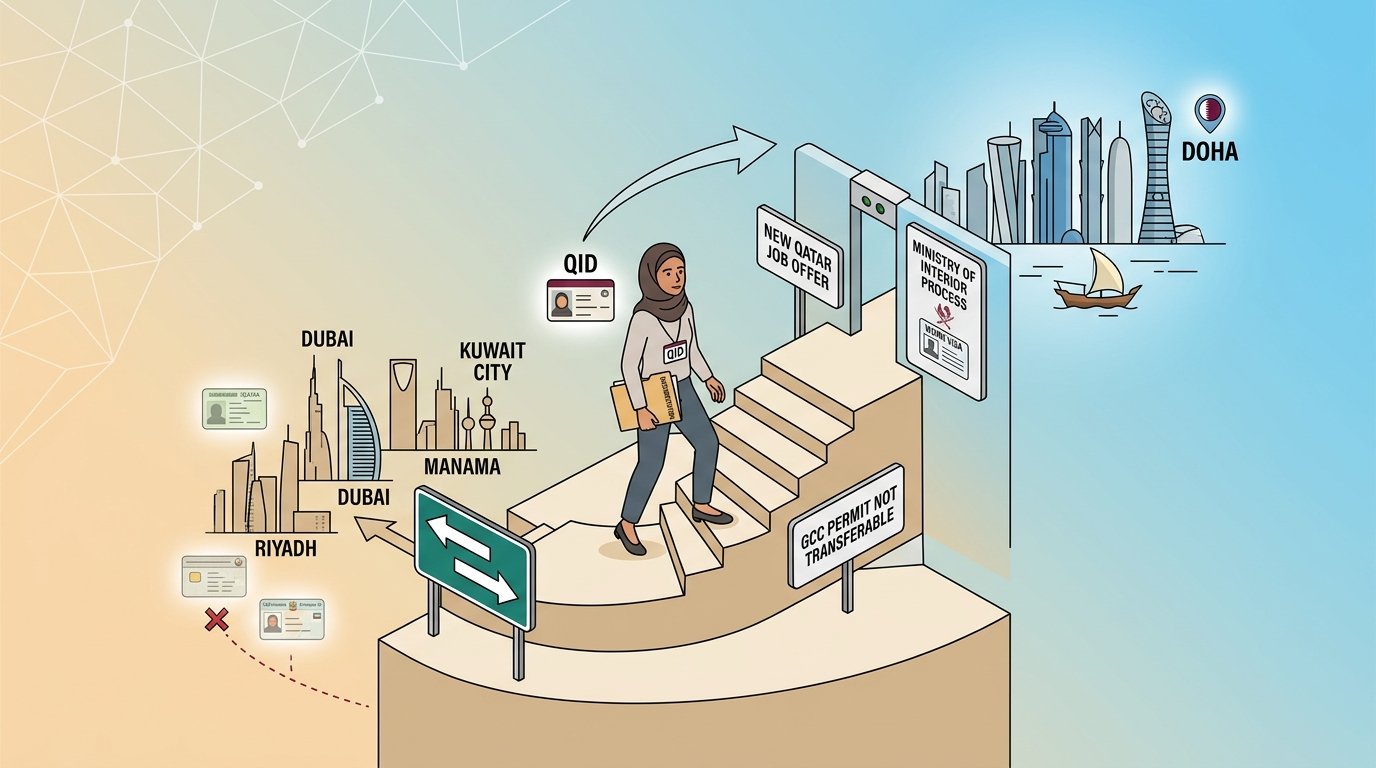
To work legally in Qatar, you need a job offer and an employer who sponsors you. There's no way around this — freelancing your way in or working on a visit visa isn't legal. The good news? In practice, reputable employers cover all the government fees tied to your work visa and residence permit.
The rough sequence looks like this:
- Receive a formal offer letter and sign an employment contract.
- Employer applies for your work entry visa so you can travel to Qatar.
- Arrive and complete a medical fitness exam and biometrics (fingerprints).
- Employer converts your visa into a Work Residence Permit and issues your Qatar ID (QID).
Once your QID is issued, you're a legal resident — you can rent a flat, open a bank account, get a mobile line and a Metro card, and start actually living here.
The government fees your employer covers
- Work entry visa — QAR 200 (single entry, valid 30 days).
- Conversion to Work Residence Permit — QAR 500, a one-time fee on arrival.
- Annual work permit fee — QAR 100
- Medical fitness exam — typically around QAR 100–150.
- Qatar ID and biometrics — around QAR 100.
If an "employer" or agent asks you to pay these fees to get a job, that's a red flag. Legitimate employers cover them.
Nailing the application and interview
With hundreds of graduates chasing the same roles, small things separate you from the pile:
- Lead with results, not duties — internships, projects, volunteering and part-time work all count.
- Have your documents ready — an attested degree certificate, passport copy and a professional photo speed things up.
- Prepare for a video interview — many first rounds happen on video before you fly in.
- Ask smart questions — about the role, the team, and yes, whether housing and transport are included.
- Be punctual and polite — Doha's professional world is well-connected, so a good impression travels.
Budgeting your first pay cheque in Doha
Doha can be affordable if you're smart about it. Shared accommodation brings your biggest cost right down — Al Sadd shared flats typically run around QAR 1,500–2,500/month, and areas like Bin Mahmoud, Najma and Old Airport offer similar value. The Metro and Karwa buses make a car optional for your first year. Cook at home, enjoy the free public beaches and parks, and save the splurges for weekend brunches. Tax-free income means whatever you earn, you keep — so start a savings habit from month one.
Ready to make the leap? Explore entry-level and graduate jobs in Qatar and find your first flat in our Qatar properties listings once you've signed.
FAQs
Do I need to be in Qatar to apply for my first job?
No. Most fresh graduates apply online from abroad, do a video interview, receive an offer, and only travel once the employer arranges the work entry visa. You'll complete the medical and QID steps after you arrive.
Who pays for my work visa and QID?
Your employer. Your employer. In practice they usually cover the work entry visa, the residence permit conversion, the annual work permit fee, and related government charges. If someone asks you to pay these to secure a job, be very cautious.
What's the lowest salary I can legally be offered?
Qatar's minimum wage guarantees a QAR 1,000 basic salary, plus QAR 500 housing and QAR 300 food allowance if those aren't provided — a QAR 1,800 minimum package. Most graduate professional roles pay well above this.
Is my salary really tax-free?
Yes. Qatar does not charge personal income tax on salaries, so your take-home pay is your full salary. That's a big reason to build a savings habit early.
Which sectors pay fresh graduates the most?
Junior professional roles in oil & gas, IT and healthcare typically sit around QAR 7,000–10,000/month, and some large construction firms offer graduate packages around QAR 9,400 plus lodging, meals and transport.
Can I change jobs after my first one?
Yes. Qatar's labour rules allow workers to change employers, though notice periods and procedures apply. Read your contract carefully before signing so you understand your terms from day one.
---
About Qatar Living :
Since 2005, Qatar Living has been the trusted destination for everything Qatar. As the country's largest online community and marketplace, Qatar Living connects people with opportunities through jobs, property, vehicles, services, classifieds, events, local insights, and breaking news. Trusted by residents, newcomers, visitors, and businesses alike, Qatar Living brings Qatar together in one place.
Follow Qatar Living for daily updates:
Instagram - @qatarliving
X - @qatarliving
Facebook - Qatar Living
YouTube - qatarlivingofficial
Up Next

Internships in Qatar: How to Find & Land One
Internships in Qatar: how to find and land one as a student or fresh grad. Where to search, how to apply, pay expectations and CV tips for young residents.
Aug 5,2026
Labour Law Changes in Qatar 2026: Expat Guide
Labour law changes in Qatar 2026 explained: minimum wage, NOC, e-contracts, overtime, wage protection and dispute rules every expat worker should know.
Jul 27,2026
Expat Work Visa Rejection: Reasons & How to Appeal
Learn why Qatar work visas get rejected, common reasons, employer requirements, and how to appeal or fix your application for approval.
Jul 26,2026
Healthcare Jobs in Qatar: Visa Sponsorship Guide
Healthcare jobs in Qatar for nurses, doctors & allied roles with visa sponsorship. Employers, salaries, licensing, DHP steps & fees explained for expats.
Jul 26,2026