Labour Law Changes in Qatar 2026: Expat Guide

The Ministry of Labour's Law No. 9 of 2026 amends Labour Law No. 14 of 2004, modernising some employment rules and tightening enforcement, but part‑time and freelance workers are expressly excluded from the Labour Law’s scope.
The Council of Ministers may, on the Minister of Labour’s recommendation, extend selected Labour Law protections to these workers or adopt a separate regime in future.
Part‑time and freelance work is not yet fully covered by the Labour Law; instead, Law No. 9 of 2026 clarifies that they are outside the main framework, with potential future regulation via separate decisions.
The changes modernise how employment works, tighten worker protections. Here is a plain-English breakdown of the Labour Law changes in Qatar 2026: what expat workers need to know, and exactly what they mean for you.
The short version: your minimum pay is protected, you can still switch employers without your boss's permission, all contracts must now be digital, and penalties for underpaying wages have real teeth. Let's go through it.
Key changes at a glance
- Law No. 9 of 2026 strengthens the trend toward digital, registered employment contracts, with the Ministry of Labour’s e‑systems increasingly used to register and verify contracts. Workers should ensure their contract is registered electronically, as the official record is what authorities rely on in disputes.
- Law No. 9 of 2026 clarifies that part‑time and freelance workers sit outside the main Labour Law framework. It empowers the Council of Ministers to extend some protections to them or to create separate rules, but as of mid‑2026 they are not fully covered by the Labour Law itself.
- The NOC remains abolished — you can change jobs without employer consent.
- Employers who fail to pay wages can face fines in the low‑thousands per violation (in the QAR 2,000–10,000 band) and, in serious or repeated cases, imprisonment, with monitoring carried out through the Wage Protection System.
- Minimum wage is unchanged and still applies to all workers.
Minimum wage in 2026 — what you should be paid
Good news first: the minimum wage has not been cut. It remains as set under Law No. 17 of 2020, which applies to all workers regardless of nationality or sector.
- Basic wage: QAR 1,000
- Housing allowance: QAR 500 per month — payable if your employer does not provide accommodation.
- Food allowance: QAR 300 per month — payable if your employer does not provide food.
Put together, if you receive neither housing nor food, your effective minimum is QAR 1,800 per month. If you are offered less than the legal basic wage, that offer does not comply with Qatari law — verify the terms before you sign.
Changing jobs: the NOC is still gone
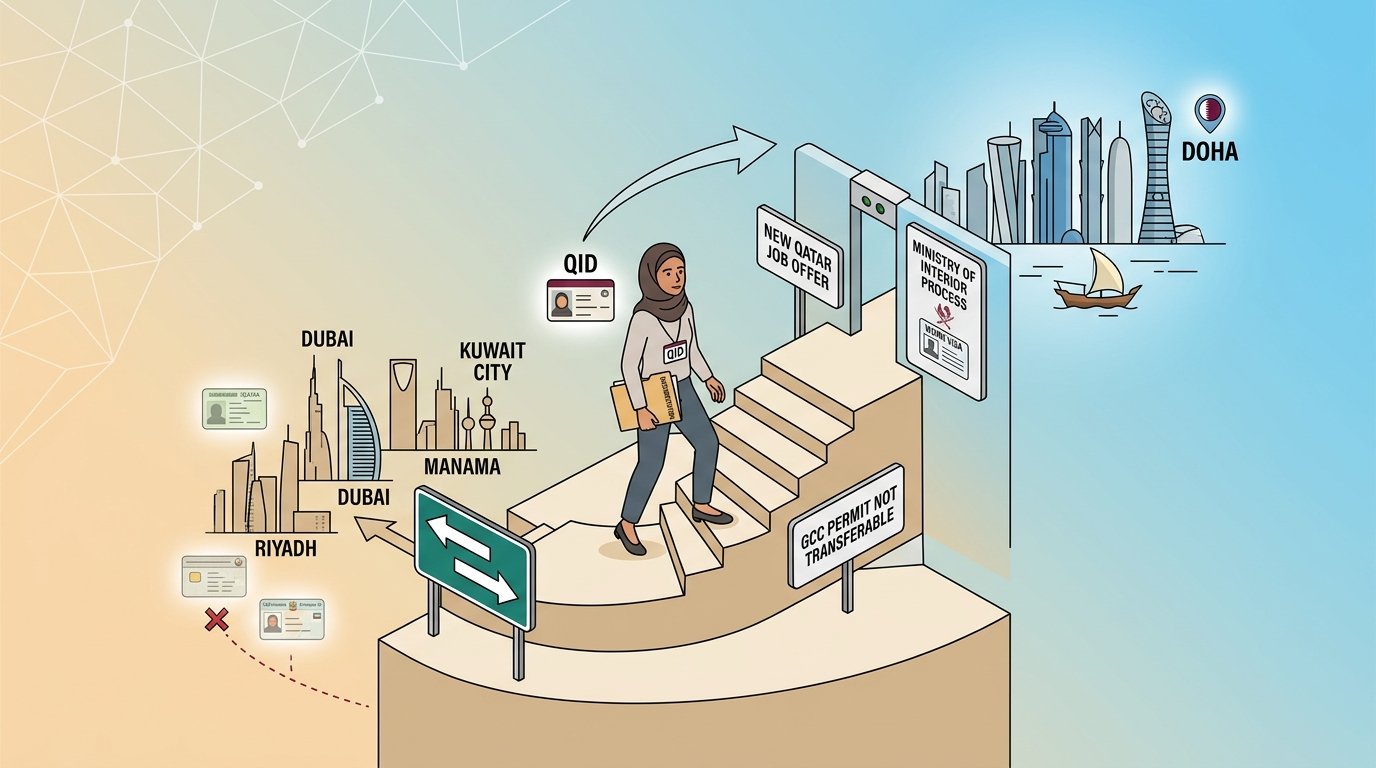
One of the most important reforms of recent years stays firmly in place: the No-Objection Certificate (NOC) remains abolished. You do not need your current employer's consent to move to a new one.
You change jobs through the Ministry of Labour electronic systems, subject to serving your contractual notice period and following the official procedure. This is the change that gave expat workers real mobility in Qatar's labour market, and 2026 keeps it.
What about notice periods?
Freedom to move is not the same as walking out overnight. You still owe your employer the notice period written into your contract. Serve it properly, submit your transfer through the Ministry of Labour portal, and your move is clean and legal.
E-contracts are now mandatory
This is a big practical shift. Employment contracts must now be registered through the Ministry of Labour E-Contract system to be legally valid and enforceable. A handshake, a WhatsApp message, or a paper contract that was never registered will not carry the same legal weight.
What this means for you:
- Before you start: make sure your job offer is turned into a registered digital contract, not just a signed PDF.
- Check the details: your job title, salary, allowances, working hours and notice period should all match what you were promised.
- Keep your access: the digital record is your proof if a dispute ever arises.
Part-time and freelance work is now legal
For the first time, Law No. 9 of 2026 formally recognises part-time and freelance work and brings these arrangements inside the Labour Law framework. Until now, flexible work sat in a grey area; from 2026, it can be done under regulated, above-board conditions.
For expats juggling multiple income streams — teachers, designers, IT contractors, consultants — this is a meaningful upgrade. It means a legitimate legal basis for part-time and freelance arrangements rather than informal side deals.
Non-compete clauses — the new limits
Alongside the freelance changes, non-compete clauses are now specifically regulated. They are still allowed, but subject to clearer limits designed to balance your right to move jobs against an employer's legitimate business interests. If a contract tries to lock you out of your entire profession for years, that is exactly the kind of overreach the new rules are meant to rein in — read the clause carefully before signing.
Working hours, breaks and Ramadan
The core limits on working time are unchanged and firmly protected:
- Standard hours: a maximum of 8 hours
- Ramadan: reduced to 6 hours
- Breaks: a mandatory 1-hour break after 5 consecutive working hours.
Remember too that summer outdoor work is separately restricted during the hottest months — a protection that runs alongside these general hour limits.
Overtime pay
If you work beyond your normal hours, you must be paid extra:
- Standard overtime: at least 125% of your basic wage.
- Night work, public holidays and rest days: up to 150% of your basic wage.
- Under the Labour Law, overtime pay must include a premium (commonly at least 25% above basic for ordinary overtime and higher rates for night, holiday or rest‑day work), with detailed percentages set by regulation. Law No. 9 of 2026 does not alter these core rules.
Wage protection and stronger penalties
The 2026 reforms sharpen the tools that make sure you actually get paid, on time. Monitoring of salary payments through the Wage Protection System has been strengthened, and the consequences for employers who fail to pay are now serious.
- Fines for wage violations: typically between QAR 2,000 and QAR 10,000.
- Serious cases: can carry imprisonment.
If your salary is late or short, keep records and act early — the system is designed to catch exactly this.
Faster labour dispute resolution
Nobody wants to end up in a dispute, but if you do, 2026 makes the path faster and more enforceable:
- Digital tools and enhanced mediation are used to speed up case handling.
- Labour Dispute Committee decisions now carry stronger enforceability, so a ruling in your favour is more likely to actually be implemented.
- In practice, wage‑related complaints are prioritised, with Ministry of Labour channels aiming to resolve many cases within a few weeks; Law No. 9 of 2026 emphasises faster, digital handling and stronger enforceability of Labour Dispute Committee decisions, but does not set a fixed statutory 60‑day limit.
The law also promotes joint workplace committees and social dialogue, encouraging problems to be sorted between workers and employers before they ever reach a committee.
End-of-service benefits and exit permits
Two things every expat should keep in mind:
- End-of-service benefits (EOSB): the minimum entitlement remains at least 21 days of basic wage for each completed year of service. This is a floor, not a ceiling — many contracts offer more.
- Exit permits: the requirement for most private-sector expat workers has been abolished. Exit procedures are handled through the Ministry of Interior framework, and applications can be made digitally.
Together, the mobility, wage and exit reforms mean expat workers in Qatar now have more control over their careers than at almost any point in the country's history. Understanding these changes is the best protection you have.
FAQs
Did the minimum wage change in Qatar in 2026?
No. It remains QAR 1,000 basic wage, plus QAR 500 housing and QAR 300 food allowance if these are not provided — an effective minimum of QAR 1,800
Can I still change jobs without my employer's NOC?
Yes. The No-Objection Certificate remains abolished. You can move to a new employer via the Ministry of Labour electronic systems, provided you serve your contractual notice period.
Is freelance work now legal in Qatar?
Yes. Law No. 9 of 2026 formally recognises part-time and freelance work and brings these arrangements into the Labour Law under regulated conditions.
What happens if my employer pays my salary late?
Wage violations can carry fines typically between QAR 2,000 and QAR 10,000, with imprisonment possible in serious cases. Payments are monitored through the strengthened Wage Protection System, so keep your records and raise complaints early.
How is my end-of-service benefit calculated?
The minimum is at least 21 days of basic wage for each completed year of service. Your contract may offer more, so check your terms.
Do I still need an exit permit to leave Qatar?
For most private-sector expat workers, exit permits have been abolished. Exit procedures are now handled through the Ministry of Interior framework, with digital applications available.
Now that you know your rights under the new law, put them to work: browse the latest jobs in Qatar on Qatar Living and make sure your next role comes with a properly registered e-contract. For more expat essentials, read our guides on QID renewal and relocating to Qatar.
---
About Qatar Living :
Since 2005, Qatar Living has been the trusted destination for everything Qatar. As the country's largest online community and marketplace, Qatar Living connects people with opportunities through jobs, property, vehicles, services, classifieds, events, local insights, and breaking news. Trusted by residents, newcomers, visitors, and businesses alike, Qatar Living brings Qatar together in one place.
Follow Qatar Living for daily updates:
Instagram - @qatarliving
X - @qatarliving
Facebook - Qatar Living
YouTube - qatarlivingofficial
Up Next

Expat Work Visa Rejection: Reasons & How to Appeal
Learn why Qatar work visas get rejected, common reasons, employer requirements, and how to appeal or fix your application for approval.
Jul 26,2026
Healthcare Jobs in Qatar: Visa Sponsorship Guide
Healthcare jobs in Qatar for nurses, doctors & allied roles with visa sponsorship. Employers, salaries, licensing, DHP steps & fees explained for expats.
Jul 26,2026
Visa Sponsorship in Qatar 2026: Employer Duties
Visa Sponsorship in Qatar 2026: what employers must provide — work visa, QID, contracts, medical and flights. A clear guide for expat workers.
Jul 25,2026
Salary Negotiation in Qatar: What to Ask & Red Flags
Salary negotiation in Qatar: what to ask for beyond basic pay, allowances to secure, and the contract red flags every expat should avoid before signing.
Jul 25,2026