Graduate Salaries in Qatar: What to Expect

Landed your first job offer in Qatar and wondering what number to expect on that letter? Here's the more realistic answer: there isn't one standard fresh-graduate salary in Qatar, and QAR 7,000–10,000 should be considered a strong starting offer rather than the normal market floor.
Current August 2026 salary data shows many common junior professional roles clustering closer to QAR 3,000–5,500 per month, while selected employers, specialised professions and major corporate packages can go higher.
The salary itself is also only part of the picture. Qatar does not impose personal income tax on employees' salaries, wages and allowances, while benefits such as housing, transport and health cover can materially change the value of an offer.
Whether you've just finished at one of the universities in Education City, recently graduated elsewhere and are starting your career in Doha, or you're eyeing your first move, here's a practical look at graduate salaries in Qatar and what young professionals can realistically expect.
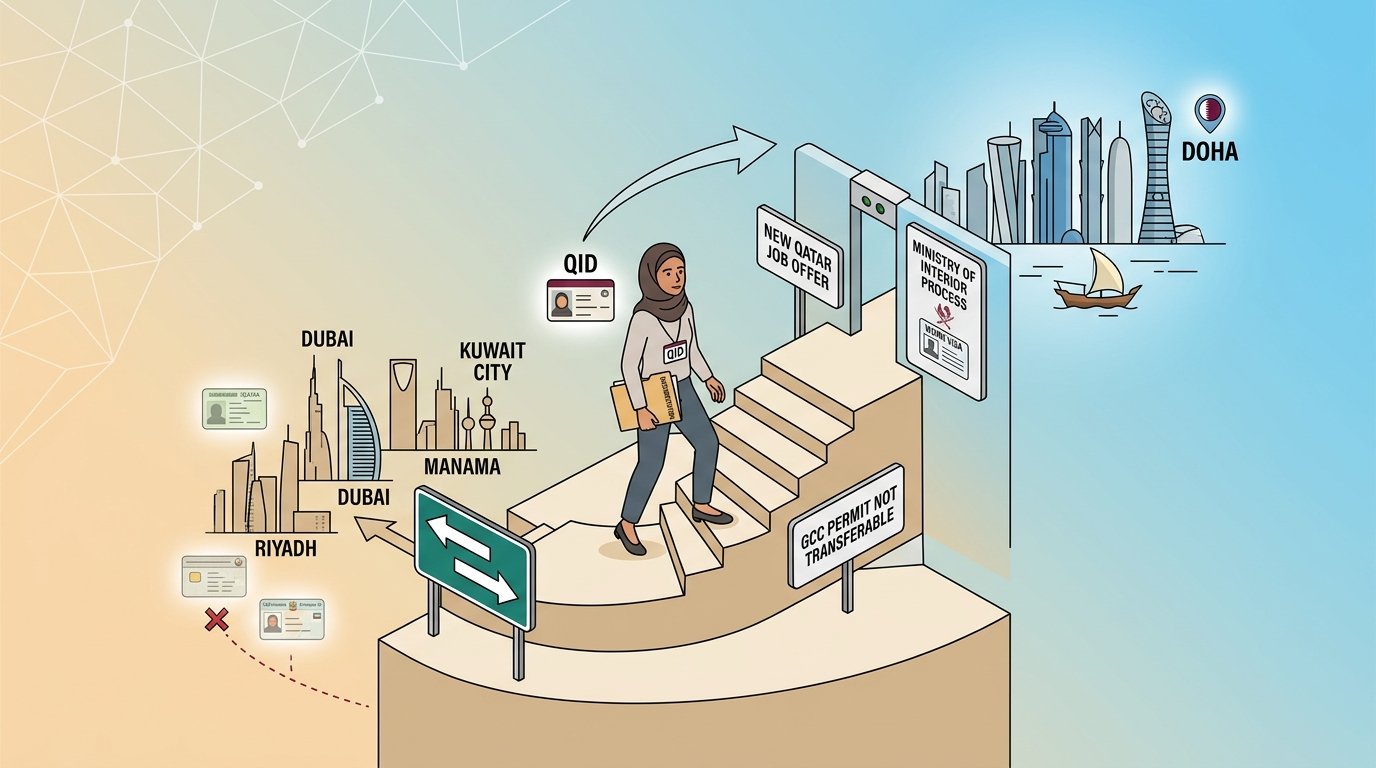
One immigration clarification: Qatar does not have a general immigration category called a “fresh graduate visa”. A non-Qatari graduate taking a job must have the appropriate work and residence status, normally arranged through the employer or another lawful sponsorship/residency route.
The quick answer: what fresh grads actually earn
There's no single "graduate salary" in Qatar — it varies enormously by profession, employer, nationality requirements, licensing, experience and benefits.
A more evidence-based 2026 picture is:
- Many junior professional roles — roughly QAR 3,000–6,000/month, depending on profession and employer.
- Stronger corporate or specialist offers — QAR 6,000–10,000+ can occur, but should not be treated as the standard fresh-graduate salary.
- Office and administrative roles — commonly around QAR 2,500–5,500/month, with current administrative-assistant averages around QAR 3,486.
- Hospitality, retail and service roles — generally lower in cash salary, often with accommodation, meals or transport depending on the employer.
One useful broad benchmark comes from Naukrigulf's “Fresher Graduate” salary dataset, which currently reports a Qatar average of approximately QAR 3,952 per month, with reported salaries from QAR 2,444 to QAR 7,000. The sample is small, so don't treat that as an official national average, but it illustrates why QAR 7,000–10,000 is too high as the default graduate range.
The right way to judge your offer is therefore by your occupation, not by the fact that you're a graduate.
Graduate salaries by sector
Office and admin roles
Entry-level office and administrative jobs — including administrative assistants, coordinators, customer-service staff and similar support roles — often sit below the QAR 4,000–8,000 band in the original article.
Current August 2026 data puts the average administrative-assistant base salary in Doha at around QAR 3,486 per month. Live listings include examples around QAR 2,000–2,500, QAR 3,000–5,000 and higher for stronger support positions.
A practical planning range for many junior admin roles is therefore around QAR 2,500–5,500/month.
Your degree, English and Arabic skills, software capability, internships and the employer's size can all affect the offer.
For related finance roles, junior accountants currently average around QAR 3,133 per month in Doha, with a reported typical range of approximately QAR 2,247–4,368.
Oil and gas, engineering, IT and healthcare
This group needs the biggest adjustment.
It is not accurate to say fresh graduates across oil and gas, IT and healthcare typically start at QAR 7,000–10,000.
Current occupation-level data shows:
- Junior engineer — approximately QAR 3,492/month on average in Doha, with a reported range of roughly QAR 2,451–4,976.
- IT support — approximately QAR 4,055/month on average in Doha.
- Registered nurse — approximately QAR 5,310/month in Doha, with a typical reported range around QAR 3,612–7,807.
- Pharmacist — approximately QAR 4,959/month in Doha, with a reported range of roughly QAR 3,060–8,037.
- Junior accountant — approximately QAR 3,133/month.
Those are market indicators rather than guaranteed starting salaries, and they combine employers of very different sizes and quality.
Selected energy companies, banks, government-linked organisations and highly specialised employers can offer packages well above these levels. But QAR 12,000–20,000+ should be described as an exceptional or premium entry-level package, not the normal expectation for a fresh graduate.
There is also an eligibility issue. Some of the country's highest-profile structured graduate schemes are designed specifically around Qatarisation. QatarEnergy currently advertises fresh-graduate opportunities for Qatari graduates, and QatarEnergy LNG's July 2026 graduate vacancies across engineering, business, finance and computer disciplines are also listed under its National Graduates programme.
Expatriate graduates should therefore distinguish between ordinary junior vacancies open to international candidates and national graduate-development programmes reserved for Qataris.
Hospitality, retail and service roles
If your first job is in a hotel, restaurant, café or retail business, salaries are generally lower but benefits can become an important part of the package.
Current market benchmarks include:
- Retail sales associate — about QAR 3,261/month on average in Doha.
- Waiter/server — approximately QAR 1,964/month on average, with current vacancies around QAR 1,700–2,000 and others above that.
Some hospitality employers provide accommodation, meals or transport, but this is employer-specific rather than automatic.
Where food and accommodation are not provided to workers covered by Qatar's minimum-wage regime, the statutory minimum is QAR 1,000 basic salary plus at least QAR 500 for accommodation and QAR 300 for food.
So always ask whether a lower cash salary includes housing, meals and transport, and whether the figure you've been quoted is basic salary or the entire package.
Salary isn't the whole story — perks that matter
In Qatar, two offers with the same headline figure can have very different real value.
Check for:
- Housing allowance or company accommodation — this can make a major difference. Current August 2026 Qatar Living listings show many private rooms in shared accommodation around QAR 1,000–2,500 per month, while independent apartments cost considerably more.
- Transport allowance or company transport — useful if your workplace is poorly served by public transport.
- Annual flight ticket — many employers include one contractually, particularly in expatriate packages, but it is not a universal statutory annual entitlement. Qatar's Labour Law instead places repatriation obligations on the employer when employment ends in the circumstances covered by Article 57.
- Health insurance — this is more than a discretionary perk. Under Qatar's healthcare law, employers are required to pay the compulsory basic health-insurance premium for their workers.
- Annual leave — employees covered by the Labour Law become entitled after a year of continuous service to at least three weeks' paid annual leave if they have under five years' service, rising to four weeks at five years or more.
- End-of-service gratuity — after at least one year of service, the statutory minimum is three weeks' remuneration for each year, calculated using the employee's last basic wage.
Always ask whether the number being quoted is:
basic salary,
basic + allowances, or
an all-inclusive package.
That matters because Labour Law entitlements such as end-of-service gratuity are linked to basic wage, not necessarily every allowance making up your monthly package.
Tax-free pay: what QAR 8,000 really means
Qatar does not impose personal income tax on employment salaries, wages and allowances.
For a typical expatriate employee, that is a genuine advantage: you do not lose part of your salary to Qatar personal income tax before it reaches you.
However, saying “QAR 8,000 gross = QAR 8,000 take-home” is slightly too absolute.
Your actual banked amount can differ because of lawful deductions, salary advances, loan repayments or other contract-specific arrangements. Qatari and GCC employees can also have social-insurance treatment that does not apply in the same way to other expatriate nationalities. PwC notes that Qatar employers have social-insurance obligations for Qatari and GCC national employees but not for employees of other nationalities.
For most expatriate graduates, the key message remains:
there is no Qatar personal income tax deducted from your employment salary.
That said, tax-free does not mean cost-free. Housing is likely to be your largest monthly expense unless your employer provides it.
How to push your first offer higher
Even as a fresh graduate, there are things you can do to strengthen your offer:
- Research the exact job title — don't negotiate from a generic “graduate salary” number. Compare junior accountant with junior accountant, IT support with IT support, and so on.
- Sell relevant experience — internships, university projects, freelance work, volunteering and technical portfolios can help separate you from candidates with only a degree.
- Negotiate the package, not just basic salary — if salary is fixed, ask whether housing, transport, relocation support or an earlier salary review can be improved.
- Build role-specific credentials — relevant technical or professional certifications can strengthen your application, although they do not automatically guarantee a higher salary.
- Ask about the review process — find out when salaries are reviewed, what performance targets matter and what progression from junior level normally looks like.
Avoid relying on a rule like “you'll jump QAR 2,000–4,000 within two years”. Some people do; others don't. Career progression depends on the occupation, performance, employer and wider market.
Cost of living reality check for young professionals
The amount you need depends heavily on whether you share accommodation or rent independently.
A useful 2026 starting point is:
- Bedspace/shared accommodation — many current Qatar Living listings fall around QAR 550–1,300/month.
- Private room in shared accommodation — commonly around QAR 1,000–2,500/month. Current listings include QAR 1,700 in Old Airport, QAR 1,800 in Najma and QAR 1,950 in Najma.
- Budget studio / 1BHK — current individual listings can start around QAR 2,800–3,200, although quality, location, furnishing and contract conditions vary substantially.
- Typical one-bedroom outside central Doha — broader cost-of-living data puts the average much higher, at roughly QAR 4,800/month, showing how much the market varies.
- Groceries for one — roughly QAR 800–1,600/month is a more useful planning range depending on where you shop, cooking habits and imported-food preferences. Current 2026 estimates range from around QAR 850 to QAR 1,600+ per month.
- Public transport — significantly cheaper than owning and running a car, especially if your home and office are close to the Metro network.
- Mobile plan — highly dependent on whether you choose prepaid, postpaid and how much data you use, so compare current Ooredoo and Vodafone offers rather than budgeting from a fixed generic figure.
This changes the salary question quite a bit.
A QAR 4,000–5,000 salary with company accommodation and transport can be workable for a single graduate.
A QAR 5,000 salary with no housing support can feel much tighter if you insist on renting your own apartment.
A QAR 7,000–10,000 package is a strong graduate-level offer in much of the current market, particularly if housing or transport is provided — but it should not be presented as what most graduates automatically receive.
Ready to compare what's actually being advertised? Browse current entry-level and graduate vacancies on Qatar Living Jobs, and compare the salary against your likely accommodation, transport and monthly living costs before accepting.
FAQs
What is the average graduate salary in Qatar in 2026?
There is no authoritative official “average graduate salary” covering every profession.
One current salary dataset for “Fresher Graduate” roles reports an average of approximately QAR 3,952/month, with a QAR 2,444–7,000 range, although the sample is small.
Occupation-specific August 2026 data shows junior accountants around QAR 3,133, junior engineers around QAR 3,492, IT support around QAR 4,055 and registered nurses around QAR 5,310.
So QAR 3,000–6,000 is a more realistic broad planning band for many ordinary junior professional roles, with stronger employers and specialist jobs paying above it.
Which sectors pay fresh graduates the most in Qatar?
Some energy, financial, specialist technical and government-linked employers can offer very strong professional packages.
However, there is not enough current public salary evidence to say that fresh graduates in oil and gas, banking, IT or healthcare frequently start at QAR 12,000–20,000.
That level should be treated as the higher end of the market rather than a standard expectation.
Also check eligibility carefully: prominent national graduate programmes at organisations such as QatarEnergy and QatarEnergy LNG specifically target Qatari graduates.
Is a QAR 8,000 salary good for a fresh graduate in Qatar?
Based on current 2026 benchmarks, QAR 8,000 is a strong offer for many fresh-graduate roles, particularly if benefits come on top.
Current averages for junior accounting, junior engineering, administration, IT support and several healthcare occupations all sit below QAR 8,000.
How good the offer actually is depends on whether the QAR 8,000 is basic salary or an all-inclusive package and whether you need to pay your own rent and transport.
Do graduate salaries in Qatar include housing and transport?
Sometimes.
Housing, transport and meals are common components of some expatriate packages, particularly in operational, hospitality and large-employer roles, but they are not automatically included in every graduate offer.
Always get the compensation structure in writing.
For lower-paid workers, Qatar's minimum-wage rules require employers to provide adequate accommodation and food or the statutory minimum allowances where applicable.
Is income in Qatar really tax-free?
Employment income is not subject to Qatar personal income tax. PwC's current 2026 tax summary confirms that salaries, wages and allowances received by employed individuals are not subject to income tax.
For most expatriate employees, that means there is no Qatar income-tax deduction from salary.
However, “tax-free” should not be confused with “no possible deductions whatsoever”.
How can a fresh graduate increase their starting salary in Qatar?
Benchmark the exact job, build relevant experience, improve the skills employers specifically request, and negotiate the entire package rather than only the basic salary.
Internships, portfolio work, professional certifications and strong language skills can all strengthen your position.
Most importantly, judge the offer against the current market for your occupation rather than aiming for an unsupported universal “graduate salary” of QAR 7,000–10,000.
About Qatar Living:
Since 2005, Qatar Living has been the trusted destination for everything Qatar. As the country's largest online community and marketplace, Qatar Living connects people with opportunities through jobs, property, vehicles, services, classifieds, events, local insights, and breaking news. Trusted by residents, newcomers, visitors, and businesses alike, Qatar Living brings Qatar together in one place.
Instagram - @qatarliving
X - @qatarliving
Facebook - Qatar Living
YouTube - qatarlivingofficial
Up Next

Five Ways to Make Your Job Search Easier
Discover five practical tips to simplify your job search, stay organised, and improve your chances of landing the right opportunity faster.
Aug 30,2026
Seven Ways to Get Your Workweek Running Smoothly Again
Discover seven practical tips to streamline your workweek, boost productivity, and ease the transition back to a busy weekday routine.
Aug 30,2026
12 Corporate Lessons You Wish You Knew Sooner
Discover 12 essential corporate lessons that can shape your career, from managing relationships to mastering documentation and networking.
Aug 10,2026
Career Fairs & Networking Events for Young People in Qatar
Your guide to career fairs and networking events for young people in Qatar — dates, who can attend, costs and tips to land your first job.
Aug 10,2026