Healthcare Jobs in Qatar: Visa Sponsorship Guide

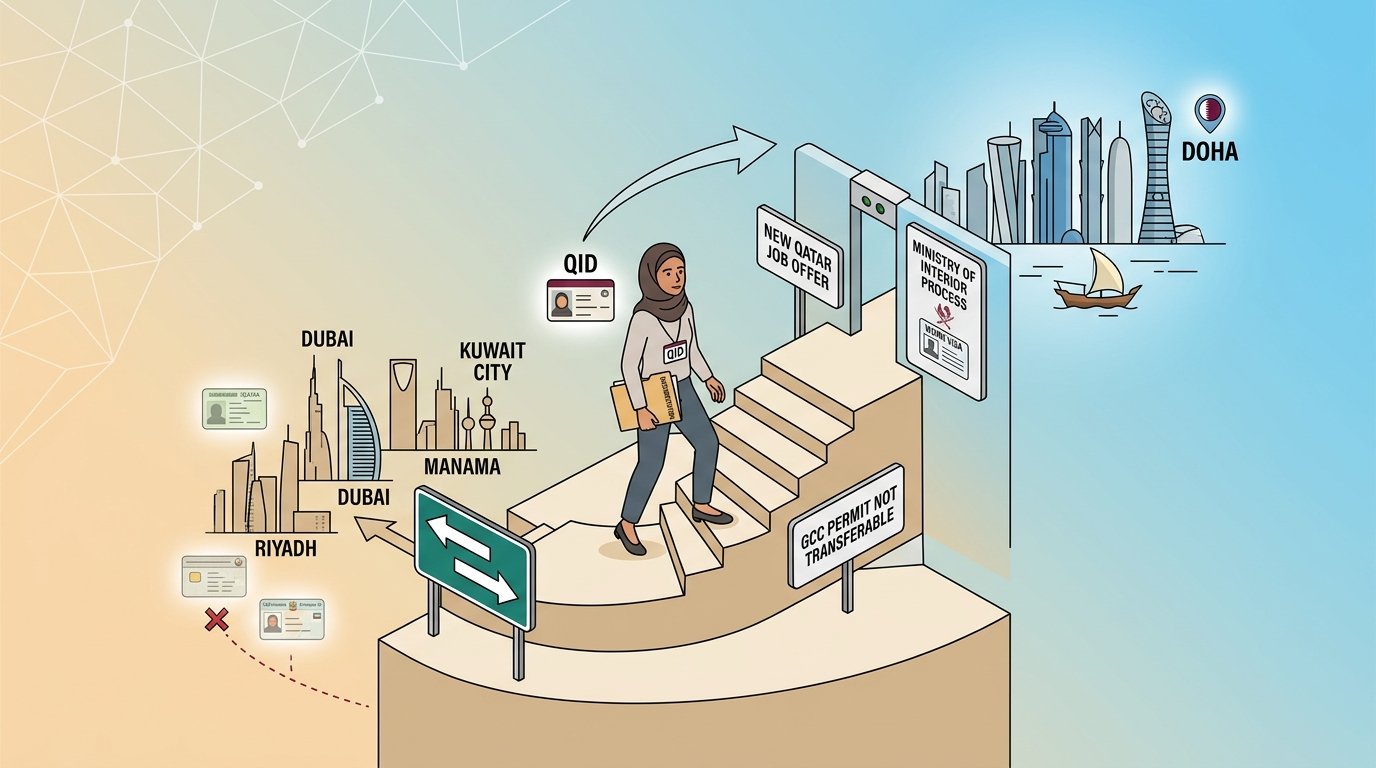
If you are a nurse, doctor or allied health professional planning a move to Doha, the most important point is that you need two separate approvals before practising legally:
- Valid permission to work in Qatar; and
- A professional licence from the Department of Healthcare Professions under the Ministry of Public Health.
For most professionals recruited from overseas, the hiring hospital, clinic or other employer arranges an employer-sponsored work entry visa and residence permit.
However, employer-sponsored residence is not the only legal route. A healthcare professional already living in Qatar under family, investor, permanent or another eligible non-work residence category may be able to retain that residence while the employer obtains a special work permit. The employer still needs to secure the correct work authorisation, and the practitioner must still satisfy all DHP licensing requirements.
You cannot legally perform paid clinical work on a tourist or visit visa. You may attend interviews while legally visiting Qatar, but you must not begin work until the required immigration, labour and professional approvals are in place.
Qatar’s healthcare system continues to recruit internationally across public healthcare, specialist hospitals, primary care and selected private-sector facilities. HMC alone employs a large multinational workforce, while Sidra Medicine, PHCC and other employers maintain dedicated healthcare recruitment portals.
This guide covers healthcare jobs in Qatar for nurses, doctors and allied health professionals: who recruits, which roles may be available, what current salary data suggest, which licences you need and how the work-authorisation process generally operates.
The information was reviewed in July 2026. Requirements remain profession- and applicant-specific, so always check the latest DHP, Ministry of Labour and Ministry of Interior instructions.
Can you work in healthcare in Qatar with visa sponsorship?
Yes. Employer-sponsored recruitment is the standard route for a healthcare professional moving to Qatar from overseas.
The employer normally applies for the required entry and employment approvals and then completes the residence-permit and QID process. Qatar’s Ministry of Interior is responsible for entry visas and residence permits, while the Ministry of Labour handles the relevant employment and work-permit processes.
However, the following distinction matters:
Employer-sponsored work residence
This is the usual route for a professional recruited from outside Qatar. The employer arranges the work-related entry visa, residence permit and work authorisation.
Family or other non-work residence
Someone already resident under family sponsorship, permanent residency, investor residency or another eligible category may be able to work without transferring their residence to the employer.
In that case, the employer applies for a special work permit authorising employment at the facility. Approval is not automatic and does not remove the requirement for DHP licensing.
Visit or tourist status
A visitor may search for jobs and attend interviews but cannot legally start working under visitor status.
Do not resign from your current role, pay recruitment charges or relocate based only on an informal offer. Obtain a written contract and verify that the employer is genuine before proceeding.
Who sponsors healthcare jobs in Qatar?
Qatar has public, specialist, industrial and private healthcare employers that recruit across clinical and support categories.
Not every vacancy is open to overseas candidates, and not every advertised role includes employer-sponsored residence. Check the individual vacancy rather than assuming that an employer sponsors every applicant.
Public-sector and specialist employers
Hamad Medical Corporation
Hamad Medical Corporation is Qatar’s principal public healthcare provider and operates hospitals and specialist services including Hamad General Hospital, Heart Hospital and the National Center for Cancer Care and Research.
Its official recruitment portal lists job families covering:
- Physicians
- Nursing and midwifery
- Allied health professionals
- Clinical support
- Administration and support services
HMC describes its workforce as multinational and accepts applications through its official careers system.
Sidra Medicine
Sidra Medicine is a specialist healthcare, research and education organisation focused particularly on women, children and young people.
Its careers portal covers clinical, medical, nursing, allied health, research and support opportunities. Sidra warns that it and its authorised recruitment partners never require job applicants to pay recruitment fees.
Primary Health Care Corporation
PHCC operates and manages primary healthcare centres across Qatar.
Its recruitment system includes categories such as:
- Physicians
- Nursing
- Pharmacy
- Laboratory services
- Radiology
- Dentistry
- Allied health
- Health information management
Vacancies and eligibility differ by role. PHCC’s official careers portal should be used rather than third-party advertisements that cannot be verified.
QatarEnergy healthcare services
QatarEnergy operates healthcare facilities and recruits for selected healthcare and occupational-health positions.
Its careers portal includes a dedicated healthcare category, and current vacancies may include physicians and other professionals serving Doha, Dukhan, Mesaieed, Ras Laffan and industrial locations.
Private hospitals and clinics
Aster Qatar
Aster Qatar operates hospitals, clinics, diagnostic services and pharmacies and maintains an official careers page for medical, nursing and other healthcare opportunities.
Al-Ahli Hospital
Al-Ahli Hospital maintains a careers section for medical and non-medical vacancies.
Candidates should apply through the hospital’s official site and verify any communication claiming to represent its recruitment team.
Other licensed hospitals, medical centres, dental clinics, pharmacies, rehabilitation providers and home-care organisations may recruit internationally.
However, phrases such as “visa provided” or “free visa” in an advertisement should not be accepted without verification. A genuine employer should issue an identifiable contract and complete the applicable Ministry of Labour and Ministry of Interior procedures.
In-demand healthcare roles with visa sponsorship
Recruitment levels change according to employer needs, government workforce planning and Qatarisation requirements.
Roles that may appear across current healthcare career portals include:
Nursing and midwifery
- Registered nurses
- ICU and critical-care nurses
- Emergency nurses
- Operating-theatre nurses
- Paediatric and neonatal nurses
- Mental-health nurses
- Community and home-care nurses
- Midwives
- Clinical nurse specialists
- Nurse educators and managers
HMC states that it is moving toward a bachelor’s-degree nursing workforce, with a BSN used as the entry qualification for newly hired, transferred or promoted nurses and midwives within its framework. This is an HMC employment standard and should not be confused with the complete DHP classification system for every nursing scope.
Doctors
- General practitioners
- Family physicians
- Emergency physicians
- Hospitalists
- Specialists
- Consultants
- Occupational-health physicians
- Paediatric and women’s-health specialists
- Surgeons and other procedural specialists
Doctors must satisfy the DHP requirements for the exact professional title being requested. A qualification suitable for registration as a general practitioner does not automatically qualify someone as a specialist or consultant.
Allied health and pharmacy
Roles may include:
- Pharmacists and pharmacy technicians
- Medical laboratory professionals
- Radiographers and imaging professionals
- Physiotherapists
- Occupational therapists
- Respiratory therapists
- Dietitians
- Clinical psychologists
- Paramedics
- Optometrists
- Speech and language therapists
- Anaesthesia technologists
- Other DHP-recognised scopes
DHP continues to update the regulated allied-health list and examination requirements, so candidates should check the current guideline for their specific title.
Healthcare assistants and support workers should not automatically be grouped with licensed nurses or allied-health practitioners. Whether a licence is required depends on the duties and professional scope.
Salaries: what healthcare roles typically pay in Qatar
Qatar does not publish one national salary scale covering every public and private healthcare employer.
Salary data from employment platforms are self-reported and often combine different grades, specialties and benefit structures. They should be used as market indicators rather than guaranteed pay bands.
Staff nurses
Current self-reported data on Indeed place average registered-nurse pay in Qatar at approximately QAR 5,344 per month.
Specialised nursing categories can report higher figures. Current examples include approximately QAR 7,113 for emergency-room registered nurses and QAR 7,516 for PICU registered nurses. Senior, specialist, educator and management positions may pay more, particularly where the package includes housing or other allowances.
A more defensible planning statement is:
Many general staff-nurse salaries fall around QAR 5,000 to QAR 8,000 per month in current self-reported market data, while specialist, senior and management roles may exceed that range.
Do not present QAR 6,000–12,000 as a universal standard.
Allied health professionals
Allied health is too broad for one reliable salary range.
A pharmacist, radiographer, physiotherapist, laboratory professional and clinical psychologist may have significantly different grades and packages.
For example, current Glassdoor data for pharmacists in Doha show a broad reported total-pay range of approximately QAR 5,000 to QAR 17,000 per month, with a median around QAR 8,000. This should not be applied to every allied-health profession.
Compare the exact job title, clinical grade, working hours and benefits rather than relying on a single QAR 8,000–18,000 allied-health band.
Doctors
Current Indeed data place the reported average physician salary in Qatar at approximately QAR 20,590 per month.
General practitioners, specialists, consultants, surgeons, academics and occupational-health physicians can earn very different amounts. Consultant and highly specialised roles may earn substantially more, but public employers do not publish one universal salary scale covering all specialties.
Benefits and allowances
International recruitment packages may include:
- Accommodation or a housing allowance
- Transport or a transport allowance
- Medical insurance
- Annual flight entitlement
- Paid annual leave
- End-of-service gratuity
- Education assistance for eligible children
- Relocation or temporary accommodation
- Professional-development support
These benefits are not guaranteed in every contract. Some salaries are basic pay with allowances added separately, while others are advertised as an all-inclusive amount.
Always ask for a written breakdown showing:
- Basic salary
- Housing
- Transport
- Shift or on-call allowances
- Overtime
- Flights
- Insurance
- Schooling support
- Leave entitlement
- End-of-service benefits
Qatar does not normally deduct personal income tax from employee salaries. However, workers may still have tax-reporting obligations in another country depending on their nationality and tax residence.
Licensing and qualifications you will need
Healthcare immigration approval and professional licensing are separate processes.
The Department of Healthcare Professions under the Ministry of Public Health regulates the registration and licensing of physicians, dentists, nurses, pharmacists and allied healthcare practitioners.
A work visa or QID does not authorise someone to practise clinically without the correct DHP licence.
Primary-source verification
DHP requires primary-source verification of professional documents.
The approved verification providers currently include:
- DataFlow
- Quadrabay
Verification may cover qualifications, professional licences, experience and other documents required for the requested scope.
For DHP purposes, completed primary-source verification may replace traditional embassy or government attestation of the same professional certificates. Immigration or employer processes may still request separately attested documents, so candidates should distinguish between DHP licensing requirements and residence-visa requirements.
Certificate of good standing
A valid certificate of good standing or the required verification report is generally part of the licensing stage.
Under a 2025 DHP update, practitioners must submit a primary-source verification report for the good-standing certificate rather than relying on a certificate sent by ordinary email or post.
Qualifying examination
A qualifying examination is required for the professional categories listed by DHP.
Not every practitioner takes the same exam, and some qualifications or examination pathways may qualify for an exemption. Check the current exam list for the exact profession and scope rather than assuming that every applicant must take Prometric.
Nurses
Nursing requirements depend on the requested DHP scope, such as registered nurse, nursing technician, midwife or specialist nursing role.
Applicants may need:
- A recognised nursing qualification
- Academic transcripts
- Valid or previous professional registration
- Relevant experience for the requested scope
- Primary-source verification
- A verified certificate of good standing
- A qualifying examination where applicable
- CPR or other role-specific certification
- An employer or licensed facility for the final licensing stage
DHP evaluates applications case by case and may request additional documents.
Doctors
Physician applicants may need:
- A recognised primary medical qualification
- Internship documentation
- Current or previous medical registration
- Relevant clinical experience
- Postgraduate specialty qualifications for specialist or consultant classification
- Primary-source verification
- A verified certificate of good standing
- A qualifying examination where required
- Procedure logs or privilege documents for selected specialties
- Employer and facility details for licensing and clinical privileges
The professional grade awarded by DHP depends on the recognised qualifications and experience, not simply the job title offered by the employer.
Allied health professionals
Allied-health requirements vary considerably by scope.
Applicants generally need:
- A recognised degree or diploma appropriate to the profession
- Academic transcripts
- Professional registration where applicable
- Relevant work experience
- Primary-source verification
- Good-standing verification
- A qualifying examination where required
- Any scope-specific course, training or certification
DHP publishes separate requirements for laboratory, physiotherapy, occupational therapy, optometry, radiology, respiratory care, psychology, paramedic and other allied-health categories.
Keep clear electronic copies of:
- Passport
- Degree or diploma
- Transcripts
- Internship or clinical-training records
- Professional licence
- Employment certificates
- Good-standing documentation
- Continuing professional development records
- Updated CV
- Name-change documents, if applicable
Make sure that names and dates are consistent across every document.
The recruitment and visa sponsorship process, step by step
The exact order can vary because employers may begin DHP evaluation, immigration approval and document verification in parallel.
A typical overseas recruitment process is as follows.
Secure and verify the job offer
Obtain a written offer from a licensed healthcare employer.
Confirm:
- Employer’s full legal name
- Job title and clinical grade
- Work location
- Salary and allowances
- Working hours and shifts
- Probation period
- Leave and flight entitlement
- Who pays licensing and relocation costs
- Conditions attached to joining and resignation
Apply through the employer’s official website wherever possible.
Begin DHP evaluation and document verification
The practitioner or employer begins the DHP registration and evaluation process.
Primary-source verification, good-standing checks and any required examination may take place before the final professional licence is issued. The final licensing stage is normally connected to an approved healthcare facility.
Employer arranges work authorisation
For an overseas recruit, the employer normally requests the relevant work-related entry and residence approvals.
A candidate already living in Qatar under an eligible non-work residence may instead use the special-work-permit route without transferring residence sponsorship.
Complete pre-departure procedures where applicable
Depending on nationality and recruitment route, the applicant may need to complete procedures through a Qatar Visa Centre before travel.
These may include:
- Contract review
- Medical screening
- Biometric information
- Identity checks
- Immigration documentation
A police-clearance certificate may be requested for immigration, employment or licensing purposes, but it should not be presented as a universal pre-visa document for every applicant.
Travel to Qatar
Do not travel for the purpose of starting work until the employer confirms that the correct entry approval has been issued.
Carry copies of the employment contract, entry approval, qualifications and licensing records.
Complete residence procedures
Where the required steps were not completed before departure, the employer may arrange:
- Medical fitness screening
- Fingerprints or other biometric registration
- Residence-permit processing
- Qatar ID issuance
The Ministry of Interior handles residence and identity procedures.
Complete professional licensing
The practitioner must have the applicable DHP licence and facility authorisation before independently performing regulated clinical duties.
Receiving a QID does not by itself authorise clinical practice.
Family sponsorship
Once the resident’s own QID is issued, they may separately apply to sponsor eligible family members.
For private-sector employees, current MOI guidance generally requires a specialised or technical profession and either:
- A salary of at least QAR 10,000; or
- A salary of at least QAR 6,000 with employer-provided family housing recorded in the employment contract.
Family-residence approval remains a separate MOI decision and is not automatically granted because someone holds a healthcare job.
Fees, contracts and what your employer should cover
The claim that sponsored work-visa and residence fees generally total QAR 700–800 is not reliable.
There is no single total because the transaction may involve entry approval, work permits, residence, QID issuance, medical screening, delivery and professional licensing.
Current official fee information includes approximately:
- Work permit: QAR 100 per year
- Residence permit: QAR 300 per year
- QID card: QAR 100 according to the approved residence validity
Other entry-visa, delivery or case-specific charges may apply.
Separate professional costs can include:
- Primary-source verification
- DHP evaluation or licensing fees
- Qualifying examinations
- Good-standing verification
- Document translation
- Medical screening
- Certificate or licence renewal
These costs vary by profession and application.
Genuine employer-sponsored offers
A legitimate employer may cover some or all of the following:
- Immigration fees
- DHP licensing
- Primary-source verification
- Examination fees
- Flight to Qatar
- Medical screening
- Temporary accommodation
- Permanent housing or allowance
The exact responsibility must be written into the contract or recruitment correspondence.
Avoid “free visa” offers
The term “free visa” should not be used to describe a legitimate healthcare recruitment package.
It is commonly associated with informal arrangements where a person is sponsored by one entity but works elsewhere without proper authorisation. Healthcare professionals should work only for the authorised facility and under the professional scope recorded in their DHP licence.
Do not pay a recruiter for a guaranteed position, visa or licence.
Sidra Medicine expressly warns that it and its authorised partners never ask applicants to pay recruitment fees. Similar caution should be applied to advertisements using personal email addresses, messaging apps or unofficial payment links.
Before signing, review:
- Basic salary and allowances
- Employer and work location
- Probation
- Notice period
- Working hours
- On-call arrangements
- Overtime
- Professional-liability provisions
- Licensing responsibilities
- Repayment clauses
- Housing
- Flights
- Family benefits
- End-of-service gratuity
Changing employers is possible through Qatar’s official procedures, but a healthcare practitioner may also need to update their place of work with DHP before practising at the new facility.
FAQs
Can I work in healthcare in Qatar without employer-sponsored residence?
Potentially, yes—if you already hold an eligible family, permanent, investor or other qualifying residence status.
Your employer would still need to obtain the appropriate special work permit, and you would still need a DHP licence connected to the authorised healthcare facility.
An overseas applicant without an existing Qatar residence would normally use an employer-sponsored work-residence route.
Can I work in healthcare on a visit visa?
No.
You may attend interviews while legally visiting, but you cannot begin paid work or clinical practice until the required employment, residence and DHP approvals are issued.
Which employers recruit international healthcare professionals?
Major career portals include:
- Hamad Medical Corporation
- Sidra Medicine
- Primary Health Care Corporation
- QatarEnergy
- Aster Qatar
- Al-Ahli Hospital
Not every vacancy is available to overseas candidates or includes residence sponsorship. Read the individual advertisement and apply through the employer’s official portal.
Do I need a licence to work as a nurse, doctor or allied health professional?
For regulated clinical practice, yes.
The Department of Healthcare Professions evaluates and licenses physicians, dentists, nurses, pharmacists and allied healthcare practitioners. Requirements commonly include professional qualifications, experience, primary-source verification, good-standing verification and an examination where applicable.
How much do healthcare workers earn in Qatar?
There is no universal salary scale.
Current self-reported market indicators include:
- Registered nurse average: approximately QAR 5,344 per month
- Emergency registered nurse: approximately QAR 7,113 per month
- PICU registered nurse: approximately QAR 7,516 per month
- Physician average: approximately QAR 20,590 per month
Actual offers can be lower or higher depending on employer, specialty, seniority and whether housing and other benefits are included.
How much are the visa and residence fees?
Do not rely on a fixed QAR 700–800 estimate.
Published components include approximately QAR 100 annually for the work permit, QAR 300 annually for the residence permit and QAR 100 for the QID card. Entry, delivery, medical and case-specific fees may be added.
DHP licensing, verification and examination costs are separate.
Who should pay the recruitment and visa costs?
The contract should clearly state which costs the employer covers.
Reputable employers should not require an applicant to pay a recruitment fee for receiving a job offer. Treat any request for payment to secure a vacancy or visa as a major warning sign.
Can I bring my family on my healthcare residence permit?
You may apply after receiving your own valid residence permit and QID, provided you meet the current profession, income and housing requirements.
Approval is separate from your employment and is decided by the Ministry of Interior.
Are healthcare salaries in Qatar taxed?
Qatar does not normally impose personal income tax on employee salaries.
Your home country may still apply tax or reporting rules based on citizenship or tax residence, so check your personal position before relocating.
Ready to make the move? Browse the latest healthcare jobs in Qatar on Qatar Living and apply directly to employers who sponsor foreign staff.
---
About Qatar Living :
Since 2005, Qatar Living has been the trusted destination for everything Qatar. As the country's largest online community and marketplace, Qatar Living connects people with opportunities through jobs, property, vehicles, services, classifieds, events, local insights, and breaking news. Trusted by residents, newcomers, visitors, and businesses alike, Qatar Living brings Qatar together in one place.
Follow Qatar Living for daily updates:
Instagram - @qatarliving
X - @qatarliving
Facebook - Qatar Living
YouTube - qatarlivingofficial
Up Next

Visa Sponsorship in Qatar 2026: Employer Duties
Visa Sponsorship in Qatar 2026: what employers must provide — work visa, QID, contracts, medical and flights. A clear guide for expat workers.
Jul 25,2026
Salary Negotiation in Qatar: What to Ask & Red Flags
Salary negotiation in Qatar: what to ask for beyond basic pay, allowances to secure, and the contract red flags every expat should avoid before signing.
Jul 25,2026
Salary Expectations by Job Role in Qatar 2026
Salary expectations by job role in Qatar 2026: real QAR ranges for engineering, finance, healthcare and tech, plus tips to negotiate a fair package.
Jul 24,2026
Employment Contracts in Qatar: What to Check
Employment contracts in Qatar: check salary, probation, notice, hours, overtime, end-of-service and the Arabic-text rule before you sign.
Jul 24,2026