Saudi & GCC Job Transfers to Qatar: Visa & Salary
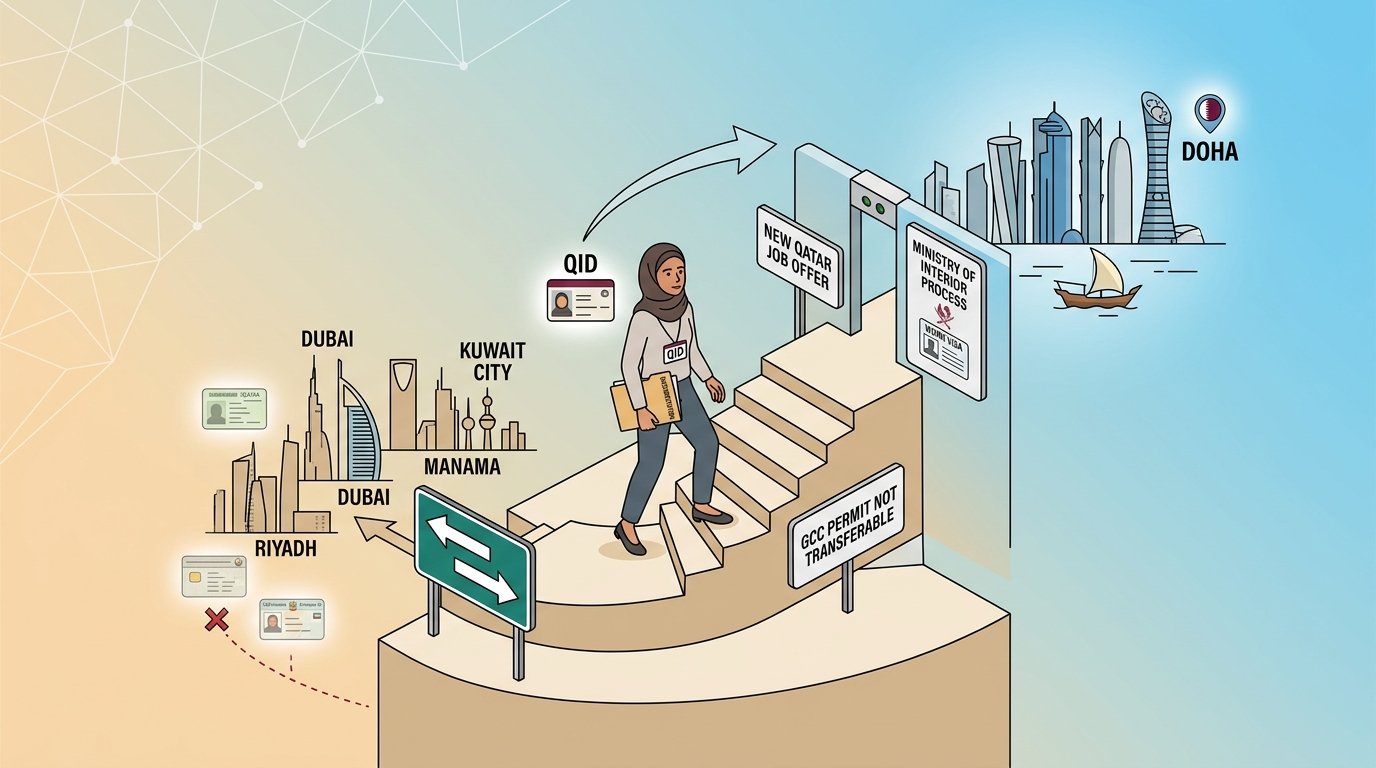
Thinking of swapping Riyadh, Dubai, Manama or Kuwait for Doha? Here's the short answer: you cannot simply transfer your Saudi, UAE, Bahraini, Kuwaiti or other GCC employment residency into Qatar.
Qatar operates its own immigration and employment system. If you're moving for a new job, you normally need a new employment relationship with a Qatar-based employer, a Qatar work-entry or employment visa arranged through the relevant government process, and ultimately a new Qatar residence permit and Qatar ID (QID). Qatar's official MOI service describes this as a Work Visa on Company Sponsorship for expatriates recruited to work for government, semi-government and private-sector employers.
Previous GCC experience can still help commercially. Familiarity with the region, local business practices and GCC clients may make your profile more attractive for certain vacancies, but it does not create a special immigration entitlement or guarantee a higher salary.
This guide covers what you need to know about moving from a Saudi or GCC job to Qatar, including visa sponsorship, residency procedures, family sponsorship and salary negotiation.
Moving from Saudi or the GCC to Qatar — the quick answer
Your Saudi iqama, UAE Emirates ID, Bahraini residence permit or other GCC residence document does not convert into a Qatar residence permit.
A GCC residence permit can sometimes affect which visitor-entry category you qualify for — Qatar operates a specific Hayya entry category for GCC residents — but visitor status is separate from the legal permission required to take employment in Qatar.
For an employment move, the process generally starts with a Qatar job offer. Your prospective employer then handles the employer-side immigration and residence procedures, while you may need to provide documents and complete medical, biometric or Qatar Visa Center requirements personally.
Once the process is completed, your Qatar residence status and QID are entirely separate from the residence permit you previously held elsewhere in the Gulf.
So the first practical step isn't transferring an iqama or Emirates ID — it's securing the Qatar job and confirming that the employer can legally recruit you for the position.
Can you transfer directly from a GCC job to Qatar?
Not through a single GCC-wide transfer process.
In practice, you'll need to:
- End or transition out of your existing employment correctly under the labour, immigration and contractual rules of the GCC country you're leaving, including any notice period or contractual obligations.
- Secure an offer from a Qatar-based employer that is authorised to recruit you for the relevant position.
- Complete Qatar's employment-entry process, including any Ministry of Labour, MOI and Qatar Visa Center requirements that apply to your nationality and profession.
- Obtain your Qatar residence permit and QID once the immigration process is completed.
Do not assume that your existing employer must issue a generic Gulf-wide “release”. Saudi Arabia, the UAE, Bahrain, Kuwait and Oman each have their own employment and immigration rules, so your exit obligations depend on the country you're leaving.
Likewise, do not cancel your existing GCC residency too early without understanding your travel, final-settlement and Qatar-entry timeline.
The GCC advantage — and its limits
Previous GCC experience can be useful when applying for Qatar roles.
You may already understand regional business practices, workplace culture, customer expectations and the realities of living in the Gulf. For jobs involving GCC clients or regional projects, that experience can be particularly relevant.
But it is an employment advantage, not an immigration shortcut.
There is no official rule giving GCC-resident expatriates priority for a Qatar work visa simply because they are already employed elsewhere in the Gulf.
Your previous salary can also be useful evidence during negotiation, but a Qatar employer will normally assess the role against its own salary structure and the Qatar labour market.
How the Qatar work visa and sponsorship process works
Once you accept an offer, your Qatar employer normally handles the employer-side work-visa and residence process through the Ministry of Labour and Ministry of Interior.
MOI's current Work Visa on Company Sponsorship service covers expatriates recruited by ministries, government organisations, public-sector entities, semi-government bodies and private companies. The listed requirements include an employment contract, appropriate educational certificates for the profession, a police-clearance certificate and medical requirements.
Step-by-step: from job offer to QID
- Employment contract — your employment terms should be documented in writing. Qatar's Labour Law requires an authenticated employment contract and says it should specify details including your profession, type of work, start date, contract duration where applicable and agreed remuneration.
- Employer begins the work-visa process — the employer applies for the relevant employment/work visa under the Qatar company sponsorship system. MOI currently lists a QAR 300 fee for the Work Visa on Company Sponsorship service.
- Complete Qatar Visa Center procedures if they apply to you — this is where the original article needs an important correction. Workers recruited from countries covered by the Qatar Visa Center system can complete their employment-contract signing, medical examination, fingerprints and biometric enrolment before travelling to Qatar.
- Travel to Qatar once the employment-entry requirements are cleared — do not assume that you can always finish everything while living in Saudi Arabia, the UAE or another GCC country. Depending on your nationality and the applicable QVC process, you may need to complete certain procedures in your country of origin before the Qatar work visa is finalised.
- Complete any remaining residence procedures — the exact steps depend on what was already completed overseas and the worker's circumstances. For a first-time company-sponsored residence permit, MOI requires documentation including the authenticated labour contract, passport, company establishment details, photograph and blood-group certificate.
- Receive your residence permit and QID — once your Qatar residency is active, your QID becomes the central identity document used for many government and private-sector services.
Once your QID and local mobile number are active, you'll also be able to use the current Metrash platform for many MOI services. The app is now called Metrash, not Metrash2.
Your QID is also commonly required when setting up services such as banking, housing contracts and other resident transactions.
Costs to expect
For an employer-sponsored employment move, separate the employer's recruitment/immigration costs from your own personal relocation expenses.
You may personally have costs such as:
- obtaining or attesting educational, marriage or other personal documents;
- relocating household belongings;
- temporary accommodation before your long-term housing is ready; and
- personal travel expenses that your employment package does not reimburse.
The employer's position should be clear in writing before you relocate.
Be especially cautious about recruitment charges.
Article 33 of Qatar's Labour Law prohibits licensed recruitment agencies from collecting recruitment fees or other recruitment charges from workers. The Ministry of Labour's current electronic employment-contract guidance also states that the worker should not bear recruitment costs.
So if a recruiter tells you that you must pay a large fee to “buy” a Qatar job, secure an employment quota or obtain the employer's work visa, treat that as a serious warning sign.
That is different from legitimate personal costs such as obtaining a police-clearance certificate or having your own documents attested where those expenses have not been contractually assumed by the employer.
Flights, relocation allowances and shipping benefits vary by employer, so don't assume they will be reimbursed unless the written offer says so.
Salary negotiation: pricing your GCC experience for Qatar
If you're moving from Saudi Arabia, the UAE or elsewhere in the GCC, don't compare only the headline monthly salary.
Compare the total Qatar package against the actual cost and benefits of relocating to Doha.
What to factor into your Qatar number
- Basic salary — identify the portion formally treated as basic pay. This matters because statutory end-of-service gratuity is calculated using the last basic wage. After one year of service, Qatar's Labour Law provides for a minimum gratuity of three weeks' remuneration for every year worked.
- Housing — determine whether accommodation is provided, a separate housing allowance is paid, or the salary is entirely all-inclusive.
- Transport — compare an allowance or company transport against your likely commute and whether Metro access is practical.
- Education allowance — for families, school fees can materially change whether a relocation package works. Education support is contractual rather than automatically guaranteed.
- Flights — some expatriate packages include annual or periodic home-leave tickets, but this is not a universal annual statutory benefit. Qatar's Labour Law separately places repatriation costs on the employer when employment ends in the circumstances covered by Article 57.
- Health insurance — employers are required under Qatar's healthcare law to pay the compulsory basic health-insurance premium for their workers. Check separately what enhanced medical benefits and family coverage the company's plan provides.
- End-of-service gratuity — understand the basic-salary figure because this affects the statutory calculation.
- Bonus and variable pay — clarify whether any promised bonus is guaranteed, discretionary or tied to specific performance targets.
How to negotiate the offer
- Benchmark the Qatar role itself. Your Saudi or UAE package is useful context, but it isn't automatically the market rate in Doha.
- Compare total compensation. A lower headline salary can be more valuable if housing, schooling, transport and other major expenses are covered.
- Get important terms in writing. Qatar's Labour Law requires the employment contract to document the agreed remuneration, and the Ministry of Labour operates an electronic contract-authentication system.
- Don't rely solely on verbal allowances. If a housing allowance, education benefit, joining bonus or other material benefit influenced your decision to relocate, make sure it is clearly documented in the employment offer or contract.
- Use GCC experience as evidence, not entitlement. Regional clients, Arabic ability, GCC regulatory knowledge or relevant contacts can strengthen a negotiation when they directly add value to the role.
- Check the official profession/job title. The profession recorded in your employment and residence records should accurately reflect your role. It can matter for government processes; for example, current private-sector family-sponsorship rules require the employee's profession to be technical or specialised rather than a labour category.
Common pitfalls when transferring from Saudi or the GCC
A few mistakes are worth avoiding:
- Assuming your GCC residency transfers. It doesn't. Qatar issues its own work and residence documentation.
- Entering as a GCC resident visitor and assuming you can start work. Visitor-entry eligibility and legal employment status are separate matters.
- Assuming all medical and biometric steps happen after arrival. Qatar Visa Center procedures can require them before travel.
- Leaving your current Gulf employer without completing the proper process. Follow the notice, visa-cancellation, final-pay and contractual requirements of the country you're departing.
- Underestimating housing and education costs. Compare your entire Doha budget before accepting a nominal salary increase.
- Relying on verbal benefits. Document the package clearly.
- Paying recruitment fees for a job. Licensed recruiters are prohibited from charging recruited workers recruitment fees under Qatar's Labour Law.
Ready to make the move?
A move from another GCC country to Qatar can be relatively straightforward once you have the right employer and documentation, but it should be treated as a new Qatar employment and residency process, not as a transfer of your existing Gulf permit.
Use your regional experience to strengthen your application, but compare the Qatar offer on its own merits: salary, basic pay, housing, schooling, insurance, transport and relocation support.
Browse current jobs in Qatar on Qatar Living, and once the employment move becomes definite, compare housing options on Qatar Living Properties before deciding what salary package actually works for you.
FAQs
Can I transfer my Saudi iqama or UAE Emirates ID to Qatar?
No.
A Saudi iqama, UAE Emirates ID or other GCC residence permit does not convert into Qatar residency.
For employment in Qatar, a Qatar-based employer must complete the relevant work-entry and residence process, after which you receive your own Qatar residence permit and QID. MOI's current employment-entry service is the Work Visa on Company Sponsorship.
Your existing GCC residency may make you eligible for a particular Qatar visitor entry route, but that does not authorise employment.
Do I have to leave Qatar to activate the visa?
There isn't one answer that applies to every candidate.
For most people being newly recruited from abroad, the employer arranges the employment-entry process before the worker comes to Qatar.
For nationalities covered by the Qatar Visa Center programme, key steps such as the medical examination, fingerprints, biometrics and employment-contract signing are normally completed in the worker's home country before arrival.
Do not assume that entering Qatar as a visitor from another GCC country allows you to start working immediately or bypass those procedures.
Is my GCC salary a fair benchmark for Qatar?
It is a useful negotiating reference, but not an automatic Qatar market rate.
Compare the complete Qatar package, including basic salary, housing, transport, education support, health benefits, flights, bonus structure and end-of-service entitlements.
Pay particular attention to the basic-salary figure because Qatar's statutory end-of-service gratuity is calculated using the worker's last basic wage.
Should I ever pay for my Qatar work visa?
You should not pay recruitment or placement fees to buy a Qatar job.
Qatar's Labour Law prohibits licensed recruitment agencies from collecting recruitment fees or other charges from recruited workers, and the Ministry of Labour's employment-contract guidance states that recruitment costs are not borne by the worker.
You may still have legitimate personal document expenses, such as obtaining or attesting certificates, depending on your arrangement.
If someone asks for a substantial payment simply to issue an employment offer or sponsorship, verify the employer and recruiter before proceeding.
How long does the process take?
There is no reliable single official timeframe for every employment move.
Timing depends on the employer's recruitment approvals, the worker's nationality and profession, document authentication, Qatar Visa Center requirements where applicable, and completion of the residence process.
Avoid planning around a generic promise of “several weeks”. Ask the employer or PRO which approvals have already been obtained and which steps remain.
Can I bring my family?
Potentially, but obtaining your own QID is only the first step.
Current MOI criteria state that a private-sector employee generally must hold a technical or specialised non-labour profession and earn at least QAR 10,000 per month, or QAR 6,000 per month with employer-provided family housing documented in the employment contract.
For government and semi-government employees, current MOI guidance generally requires family housing from the employer or a salary of at least QAR 10,000.
Other requirements include proof of family relationship, health insurance, and current age/status rules for dependent children. MOI currently states that male children should not be over 25 and daughters must be unmarried for the standard family-residence route.
--
About Qatar Living:
Since 2005, Qatar Living has been the trusted destination for everything Qatar. As the country's largest online community and marketplace, Qatar Living connects people with opportunities through jobs, property, vehicles, services, classifieds, events, local insights, and breaking news. Trusted by residents, newcomers, visitors, and businesses alike, Qatar Living brings Qatar together in one place.
Instagram - @qatarliving
X - @qatarliving
Facebook - Qatar Living
YouTube - qatarlivingofficial
Up Next

Entry-Level Jobs in Qatar: Sectors Hiring Youth
Entry-level jobs in Qatar: which sectors are hiring young people in 2026, realistic QAR salaries, top companies and how to land your first role fast.
Aug 31,2026
Five Ways to Make Your Job Search Easier
Discover five practical tips to simplify your job search, stay organised, and improve your chances of landing the right opportunity faster.
Aug 30,2026
Seven Ways to Get Your Workweek Running Smoothly Again
Discover seven practical tips to streamline your workweek, boost productivity, and ease the transition back to a busy weekday routine.
Aug 30,2026
Part-Time & Student Jobs in Qatar: 2026 Guide
Part-time and student-friendly jobs in Qatar: real pay rates, on-campus roles, permits, and where to apply. Your budget guide for 2026.
Aug 13,2026