Writing Your First CV for the Qatar Job Market

Your CV is one of the most important documents between you and your first interview — and the Qatar job market has its own quirks. Once you know what recruiters here expect, writing your first CV for the Qatar job market is genuinely straightforward. Practices vary by employer and sector, so treat the guidance below as a strong baseline, not a rigid rule.
Whether you're chasing your first role in marketing, hospitality, engineering or admin, this guide covers the format, the must-have sections, the Qatar-specific details recruiters look for, and the beginner mistakes that get CVs binned before anyone reads them.
Start here: what a Qatar CV actually needs
A Qatar CV isn't wildly different from a Western one, but a few local expectations trip up first-timers. Recruiters here typically want your nationality, your visa/QID status, and often your date of birth and marital status stated up front — details you'd often omit on a CV in the UK or US. Requirements vary by employer and industry, so always check the specific job ad and company preferences.
Don't overthink it. A clean, honest, well-structured document beats a flashy template every time. Let's break it down.
How long should your CV be?
Two pages is the sweet spot for most professional roles in Qatar. As a fresh graduate or first-jobber you might comfortably fit onto a single strong page — that's totally fine and often better. Two to three pages are widely accepted for experienced professionals, with three pages usually reserved for senior or highly technical roles. Different employers have different preferences, so prioritise clarity over length.
- First job / fresh grad — 1 page, tightly focused
- Most professional roles — 2 pages
- Senior / technical roles — up to 3 pages
Format and layout that gets read
- Keep it simple and machine-friendly. Many larger Qatar employers and recruitment agencies run CVs through applicant tracking systems, and fancy layouts can confuse them. Smaller firms may read PDFs directly, but a clean layout still helps.
- Save as PDF — always submit as a PDF for online applications and email, so your formatting doesn't break on the recruiter's screen
- Single-column layout — avoid tables, text boxes, columns and heavy graphics that scramble in automated systems
- Clean fonts — Calibri or Arial at 10–12pt for body text
- Consistent headings — clear section titles, plenty of white space, no rainbow of colours
That Canva template with three columns and a pie chart of your "skills"? Save it for your portfolio, not your Qatar CV.
The core sections of a Qatar CV
Include these sections, roughly in this order:
- Personal details
- Professional summary
- Work experience (reverse chronological)
- Education
- Skills
- Certifications / licences
- Languages
- References (optional, but commonly included)
Personal details (the Qatar-specific bits)
This is where Qatar often differs from what you're used to. Many employers expect:
- Full name
- Mobile number with the Qatar code +974 (or your current number if you're still abroad)
- Professional email — firstname.lastname@… , not partyanimal2003@…
- Location — e.g. "Doha, Qatar" or your current country if applying from overseas
- Nationality — state it clearly
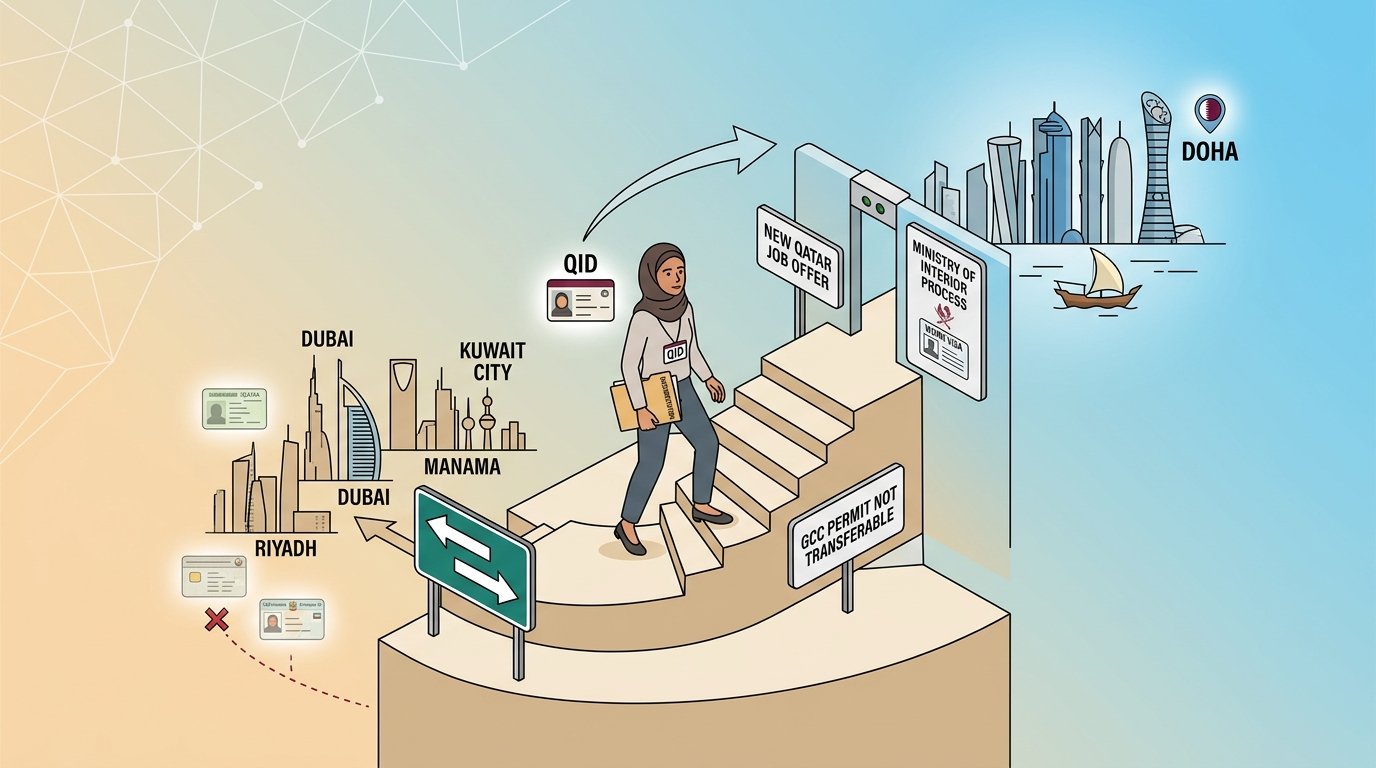
- Visa / QID status — this matters a lot here. For example: "QID holder, transferable sponsorship", "Family sponsorship", or "Based abroad, open to relocation"
- Date of birth — commonly requested on Qatar CVs
- Marital status — often expected here
- Driving licence (optional) — mention a Qatar or GCC licence if the role involves travel
Your visa status is a big deal for local recruiters. If you already hold a QID with transferable sponsorship, say so loudly — it can move you to the top of the pile, because the employer avoids the visa hassle.
Professional summary
A short, punchy paragraph of 2–5 lines right at the top, tailored to the role you're applying for. As a first-jobber, lean on your degree, your energy, and your relevant coursework, internships and transferable skills. Here are two examples for different sectors:
"Recent business graduate based in Doha with internship experience in social media and events, seeking a marketing coordinator role. QID holder with transferable sponsorship, fluent in English and conversational Arabic."
"Mechanical engineering graduate based in Doha with a final-year project in HVAC systems and a summer internship on a construction site. Eager to start as a graduate engineer. Family sponsorship, open to transfer, fluent in English."
Work experience
List jobs in reverse chronological order — most recent first. No experience yet? Internships, part-time gigs, campus roles and volunteering all count. Under each entry, use bullet points and quantify wherever you can: numbers, percentages, results.
- Weak: "Helped with social media"
- Strong: "Grew the student club's Instagram from 400 to 1,200 followers in 3 months"
Numbers make recruiters stop scrolling. Even small ones tell a story.
Education
Your degree, university, graduation year and any standout results or projects. As a recent grad, put education near the top — it's your strongest card. Add relevant modules or a capstone project if they line up with the job.
Skills, certifications and languages
Keep skills relevant and honest — software, tools and role-specific abilities. Under certifications, list anything current with dates. Languages matter in Qatar's diverse workplace: English is the working language for most roles, and any Arabic (even conversational) is a genuine plus. State your level clearly, e.g. "Arabic – conversational", "Hindi – native".
Should you put a photo on your CV in Qatar?
Often, yes. A professional headshot is commonly expected in Qatar and the wider Gulf, particularly for private-sector, hospitality and client-facing roles. Some employers treat it as optional, and a few prefer no photo. Where in doubt, check the job ad or company style; if you include one, keep it clean and professional.
Keep it professional: plain background, smart clothing, a natural expression. A cropped holiday selfie or a heavily filtered photo works against you. If you're unsure for a particular role, a neat headshot in the top corner is the safe default.
Sector-specific extras (engineering, healthcare, hospitality)
Some fields in Qatar require registrations and licences you should list on your CV with numbers and validity dates where applicable:
- Engineers — MMUP/UPDA registration. List it with your registration number and category where required
- Healthcare professionals — QCHP (now part of MOPH) registration for doctors, nurses, pharmacists and allied health roles, as applicable
- Energy & construction — detail your projects, contract values and any HSE (health, safety and environment) record
- Hospitality & retail — a professional photo and customer-service metrics often carry extra weight
Exact requirements vary by employer and regulator; always check the specific role and licensing body.
Common first-CV mistakes to avoid
- Sending a Word file — prefer PDF for online applications and email so nothing shifts (unless a job ad specifically asks for Word)
- One CV for every job — tweak your summary and top skills for each application
- Leaving out visa/QID status — many Qatar recruiters look for it early
- Typos and inconsistent dates — proofread twice, then ask a friend
- Overdesigned templates — pretty but often unreadable by ATS software
- An unprofessional email address — set up a clean one, it takes two minutes
Once your CV is polished, put it to work. Browse entry-level and graduate jobs in Qatar on Qatar Living and apply directly — a great starting point for first-timers hunting their first role across Doha.
FAQs
How long should a first CV in Qatar be?
As a fresh graduate or first-time job seeker, aim for one strong page. Two pages is the norm for experienced professionals, and up to three for senior or technical roles. Never pad your CV just to fill space. Some employers prefer shorter CVs; tailor length to the role and your experience.
Do I need to put my nationality and visa status on a Qatar CV?
In most cases, yes. Qatar recruiters typically expect your nationality and visa/QID status. If you hold a QID with transferable sponsorship, state it clearly — it can give you an edge because it saves the employer the visa process. Some international or remote-first employers may follow different norms; follow the job ad and company style.
Should I include a photo on my CV in Qatar?
Often yes. A professional headshot is commonly expected in Qatar and the Gulf, especially for hospitality and client-facing roles. Keep it professional — plain background, smart clothing, no filters or selfies. Some employers prefer no photo; where possible, check the job ad or company norms.
What file format should I send my CV in?
Always PDF for online applications and email. A PDF keeps your layout intact on any device, while a Word file can shift and look messy on the recruiter's screen.
What if I have no work experience yet?
Lean on internships, part-time jobs, campus roles, volunteering and relevant coursework. Quantify what you achieved, put your education near the top, and write a summary that sells your potential and energy.
Is Arabic required to get a job in Qatar?
Not usually — English is the working language for most private-sector roles. But any Arabic, even conversational, is a real bonus. List your language levels clearly on your CV. For government, semi-government and some customer-facing roles, Arabic may be more important or even required.
---
About Qatar Living :
Since 2005, Qatar Living has been the trusted destination for everything Qatar. As the country's largest online community and marketplace, Qatar Living connects people with opportunities through jobs, property, vehicles, services, classifieds, events, local insights, and breaking news. Trusted by residents, newcomers, visitors, and businesses alike, Qatar Living brings Qatar together in one place.
Follow Qatar Living for daily updates:
Instagram - @qatarliving
X - @qatarliving
Facebook - Qatar Living
YouTube - qatarlivingofficial
Up Next
Your First Job in Qatar: A Fresh Graduate's Guide
Landing your first job in Qatar as a fresh graduate? Real salaries, visa fees, the minimum wage and how to get hired — all in one practical guide.
Aug 6,2026
Internships in Qatar: How to Find & Land One
Internships in Qatar: how to find and land one as a student or fresh grad. Where to search, how to apply, pay expectations and CV tips for young residents.
Aug 5,2026
Labour Law Changes in Qatar 2026: Expat Guide
Labour law changes in Qatar 2026 explained: minimum wage, NOC, e-contracts, overtime, wage protection and dispute rules every expat worker should know.
Jul 27,2026
Expat Work Visa Rejection: Reasons & How to Appeal
Learn why Qatar work visas get rejected, common reasons, employer requirements, and how to appeal or fix your application for approval.
Jul 26,2026