Kafala & Sponsorship in Qatar 2026: Expat Guide

If you are working in Qatar in 2026, the key thing to know is that the country's former kafala system has undergone major reforms.
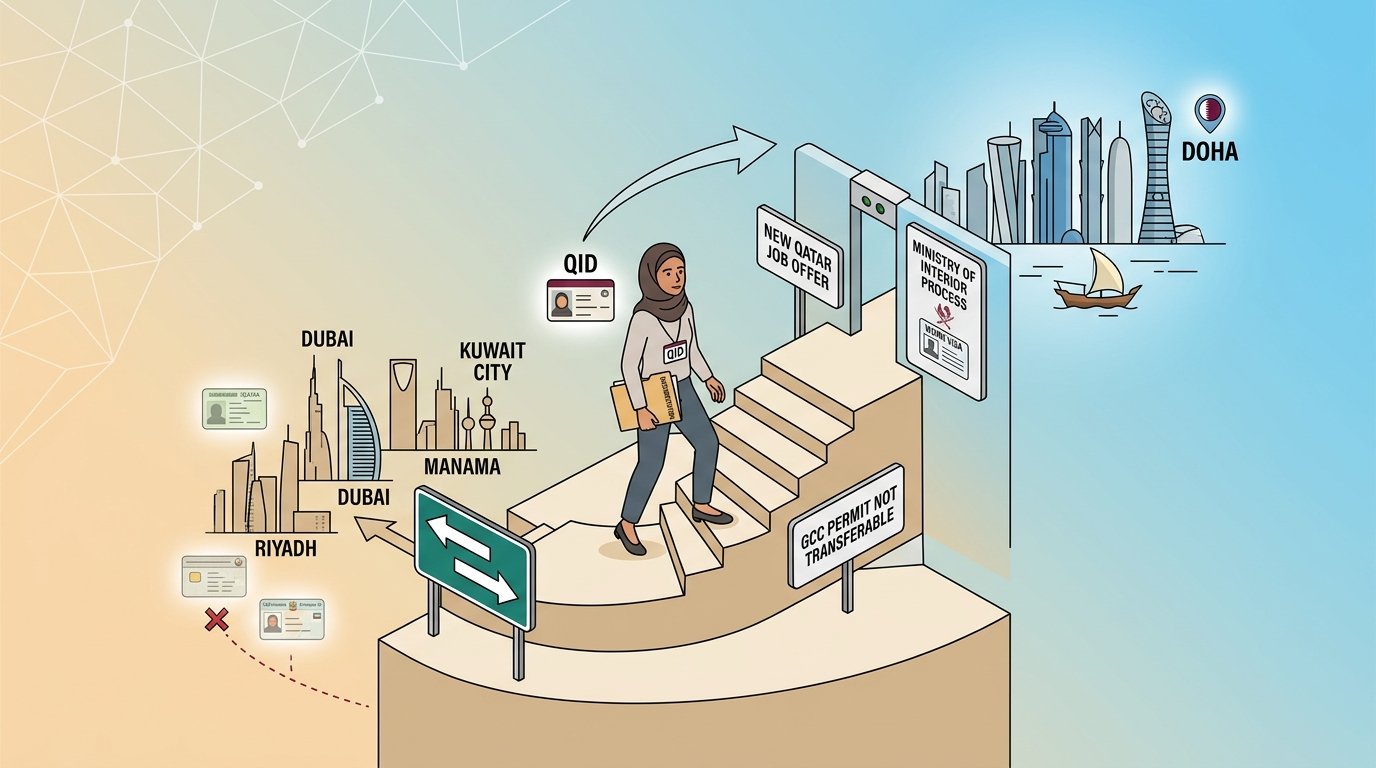
Expatriate workers still need a valid residence and work status linked administratively to an employer, while spouses and children can hold residence under a family sponsor. But two of the most restrictive features of the former system have been removed: most workers no longer need an exit permit to leave Qatar, and workers no longer need a No-Objection Certificate (NOC) from their employer to change jobs.
Here's a plain-English guide to sponsorship, changing jobs and family residence in Qatar in 2026.
What sponsorship means in Qatar today
Qatar law still assigns responsibility for an expatriate resident to a sponsoring party.
For an expatriate worker, that is generally the employer. For family members living in Qatar under family residence, responsibility generally sits with the head of the family sponsoring them.
That does not mean an employer has the same control that existed under the former kafala system.
Major labour reforms removed the general requirement for employer permission to:
- Change jobs
- Leave Qatar temporarily
- Leave Qatar permanently
The International Labour Organization describes these reforms as effectively dismantling the traditional kafala system.
Two major reforms expat workers should know
Most workers no longer need an exit permit
Almost all migrant workers can now leave Qatar without obtaining prior permission from their employer.
This applies to temporary trips as well as permanent departure.
There are limited exceptions.
Employers can seek approval for exit-permit requirements to continue applying to a small number of employees in key positions, capped at 5% of the workforce, subject to the applicable rules. Members of the armed forces are also outside the general abolition.
Domestic workers also no longer require an employer-approved exit permit, but they must notify their employer at least 72 hours before leaving the country. Employer approval itself is not required.
You no longer need an NOC to change jobs
Workers in Qatar can change employer without first obtaining a No-Objection Certificate from their current employer.
Law No. 19 of 2020 removed the NOC requirement, allowing migrant workers to change jobs before the end of their contract provided the legal procedures and notice requirements are followed.
This does not mean you can simply start working for another company immediately.
The employer change still has to be processed legally through the Ministry of Labour, and you must generally observe the required notice period.
Changing jobs in 2026: the notice period
After probation, Qatar's Labour Law sets the standard notice period at:
- 1 month if you have worked for your employer for two years or less
- 2 months if you have worked for the employer for more than two years
The notice must be given in writing.
The Ministry of Labour's current Change Employer Form also states that the date the change-employer application is submitted marks the beginning of the notice period with the current employer.
There can be exceptions where:
- Both parties agree to waive or shorten notice
- The current employer has violated the worker's contractual or legal rights
- Different rules apply during probation
Workers should therefore follow the formal Ministry of Labour change-employer process rather than relying only on an informal resignation or verbal agreement.
What about your end-of-service gratuity?
If you have completed at least one year of service, you are generally entitled to end-of-service gratuity when your employment ends, subject to the Labour Law.
The statutory minimum is generally three weeks' remuneration for each year of service, calculated using the worker's last basic wage, with proportional entitlement for part-years after the first full year.
There are legal exceptions, so do not assume gratuity is automatically payable in every termination scenario.
Family sponsorship in Qatar in 2026
Eligible expatriate residents can apply to bring a spouse and children to Qatar under a Family Residence Visa.
The Ministry of Interior links eligibility to your residence status, occupation, employment contract, salary and — in some cases — employer-provided family housing.
Salary requirements for family residence
For private-sector employees, the current MOI requirements state that:
- Your profession must be technical or specialised and non-labour
- Your salary must be at least QAR 10,000 per month
OR
- Your salary must be at least QAR 6,000 per month
- Your employer must provide family housing
- The housing arrangement must be reflected in the employment contract.
For government and semi-government employees, the employee must have either:
- Family housing provided by the employer
OR
- A salary of at least QAR 10,000 per month as recorded in the employment contract.
Importantly, the official rules refer to the salary documented in the employment contract. It is therefore safer not to describe the threshold simply as “basic salary.”
Children, health insurance and schooling
Family-residence rules also include several conditions that parents should know.
Children's age
Under the current MOI requirements:
- Sons must not be over 25 years old
- Daughters must be unmarried.
Individual cases can still involve additional documentation, so check your family's eligibility before applying.
Health insurance
Family members being brought to Qatar must have health insurance covering the duration of their stay, effective from entry into Qatar.
School-age children
Children aged 6 to 18 must either:
- Be enrolled in a licensed school in Qatar, or
- Provide evidence that they are enrolled in education outside Qatar.
The MOI states that this is a requirement when granting or renewing their residence permit.
Documents commonly required for family residence
Current MOI requirements include documents such as:
- Sponsor's valid residence/QID details
- Passport copies
- Proof of relationship, such as an attested marriage or birth certificate
- Employment and salary information
- Evidence of qualifying family accommodation where applicable
- Health insurance
- A Police Clearance Certificate for family members aged 18 and above where required by the service.
Exact document requirements can depend on your employment category and application, so check the current application checklist before submitting.
How to process applications: Metrash, not Metrash2
One important 2026 update: Metrash2 is no longer the current Ministry of Interior app.
The Ministry discontinued Metrash2 on 1 March 2025 and replaced it with the redesigned Metrash app.
Metrash now provides access to hundreds of MOI services, including residence, visa, document and family-related services.
Some older MOI service pages may still display the wording “Metrash2”, but residents in 2026 should use the current Metrash app.
For employment changes and labour disputes, use the Ministry of Labour's employment and complaint channels, rather than treating Metrash as the main job-transfer platform.
What if your employer tries to block your job change?
Your employer can no longer require an NOC simply because you want to move to another employer.
However, you must still complete the Ministry of Labour process and follow applicable notice requirements.
If you face problems involving unpaid salary, employment rights, contract issues or a disputed job transfer, you can raise the matter through the Ministry of Labour's dispute process.
The Ministry operates labour complaint and dispute-resolution mechanisms, including Labour Dispute Settlement Committees.
Keep copies of:
- Your employment contract
- Payslips and bank records
- Written resignation or notice
- Change-employer documents
- Messages or emails with your employer
- Any relevant Ministry correspondence
Can your employer keep your passport?
As a general rule, your employer must return your passport or travel document after completing or renewing your residence procedures.
An employer may hold it for safekeeping only if you request this in writing, and it must be returned when you ask for it.
So simply confiscating an employee's passport against their wishes is not permitted.
Understanding your employment and residence rights can make a major difference when considering your next move in Qatar.
Browse Qatar Living Jobs for the latest employment opportunities across Qatar.
FAQs
Do I still need an NOC to change jobs in Qatar in 2026?
No.
Workers can change employers without obtaining a No-Objection Certificate from their existing employer, provided they complete the required Ministry of Labour procedure and observe the applicable notice period.
How much notice do I need to give?
After probation:
- 1 month during your first two years with the employer
- 2 months after completing two years.
Can my employer stop me from leaving Qatar?
For almost all migrant workers, an employer-approved exit permit is no longer required.
Limited exceptions remain for certain key employees and members of the armed forces. Domestic workers can leave without permission but must notify the employer at least 72 hours in advance.
What salary do I need to sponsor my family?
For private-sector employees, the current MOI threshold is:
- QAR 10,000 salary, or
- QAR 6,000 plus employer-provided family housing
The profession must also be technical or specialised and non-labour.
Government and semi-government employees need employer-provided family housing or a salary of at least QAR 10,000.
Until what age can I sponsor my children?
Current MOI rules state that sons must not be over 25, while daughters must be unmarried.
Children aged 6–18 must also meet the schooling requirement.
Where do I process family residence applications?
Use the Metrash app and Ministry of Interior residence services.
Metrash2 was discontinued in March 2025.
Is health insurance required for family residence?
Yes. The current MOI requirements state that family members must have health insurance covering the duration of their stay in Qatar.
About Qatar Living:
Since 2005, Qatar Living has been the trusted destination for everything Qatar. As the country's largest online community and marketplace, Qatar Living connects people with opportunities through jobs, property, vehicles, services, classifieds, events, local insights, and breaking news. Trusted by residents, newcomers, visitors, and businesses alike, Qatar Living brings Qatar together in one place.
Instagram - @qatarliving
X - @qatarliving
Facebook - Qatar Living
YouTube - qatarlivingofficial
Up Next

Graduate Salaries in Qatar: What to Expect
Graduate salaries in Qatar decoded: real QAR pay ranges by sector, perks, and negotiation tips for young professionals starting out in Doha.
Aug 31,2026
Entry-Level Jobs in Qatar: Sectors Hiring Youth
Entry-level jobs in Qatar: which sectors are hiring young people in 2026, realistic QAR salaries, top companies and how to land your first role fast.
Aug 31,2026
Five Ways to Make Your Job Search Easier
Discover five practical tips to simplify your job search, stay organised, and improve your chances of landing the right opportunity faster.
Aug 30,2026
Seven Ways to Get Your Workweek Running Smoothly Again
Discover seven practical tips to streamline your workweek, boost productivity, and ease the transition back to a busy weekday routine.
Aug 30,2026