Career Progression for Expats in Qatar: Timelines

If you're moving to Doha and wondering how long it takes to go from your first job to a senior role, here's the honest answer on career progression for expats in Qatar and realistic timelines: most professionals reach a solid mid-level position within three to seven years, and a genuine senior or management role usually lands somewhere after the seven-year mark — often faster in high-demand sectors like oil and gas, finance and healthcare. Qatar rewards specialists, and since the old No Objection Certificate (NOC) requirement was scrapped, changing employers to level up is far easier than it used to be.
How fast can expats actually climb the ladder in Qatar?
Progression here is less about time served and more about scarce skills, results, and a strong professional network. An engineer with a niche specialisation or a nurse with critical-care experience can jump levels far quicker than someone in a crowded, generalist field.
That said, there's a rough rhythm most expat careers follow. Below are the three main stages, the salary bands you can realistically expect in 2026, and how long each typically lasts before the next jump.
The three career stages — and realistic salary bands
Entry level (0–3 years)
This is where most graduates and early-career professionals land. Expect a gross package typically around QAR 7,000 to 10,000 per month for professional roles, usually with housing and transport either provided or paid as an allowance.
- Typical roles: junior engineer, staff nurse, sales executive, accountant, IT support, hospitality supervisor.
- Focus: earning local experience, building a reputation, and understanding how business is done in Qatar.
- Time to next stage: usually 2–4 years with visible results.
Mid level (3–7 years)
Once you've proven yourself, you move into supervisory or specialist territory, with packages typically around QAR 11,000 to 15,000 per month gross — and considerably higher in technical fields.
- Typical roles: project engineer, team lead, senior accountant, IT/software engineer (often QAR 10,000–22,000), department supervisor.
- Focus: managing people or complex projects, gaining certifications, and becoming the person others rely on.
- Time to next stage: 3–5 years, faster if you switch employers strategically.
Senior level (7+ years)
Senior and management roles start typically around QAR 20,000 to 30,000 per month, and climb well beyond that in oil and gas, finance and healthcare — where packages of QAR 25,000 to 45,000 per month are common for the right specialists.
- Typical roles: finance manager (often QAR 18,000–32,000), petroleum engineer (QAR 25,000–45,000), department head, country manager.
- Focus: strategy, budgets, and leading teams — often across multiple sites in Doha, Lusail and beyond.
Realistic timelines by sector
Not every industry moves at the same speed. Here's how progression tends to play out across Qatar's biggest employers:
- Oil, gas and petrochemicals: the fastest-paying track. Specialists can hit senior packages within 6–8 years, with petroleum engineers commanding QAR 25,000–45,000/month.
- Finance and banking: strong, structured progression; a finance manager role (QAR 18,000–32,000) is realistic within 7–10 years.
- Healthcare: demand is high and steady — critical specialisms progress quickly, though credentialing takes time.
- Aviation: Doha's status as a global hub means clear ladders, especially for engineering and operations roles.
- Engineering and construction: Qatar's ongoing infrastructure pipeline keeps demand high; project experience is the fastest accelerator.
- Hospitality: a hotel manager typically earns QAR 8,000–15,000/month, with progression tied heavily to property size and brand.
What speeds up (or slows down) your progression
Two people with identical CVs can end up years apart in career terms. The difference usually comes down to a handful of factors:
- Certifications and attested qualifications — a genuine accelerator, especially in engineering, finance and healthcare.
- Willingness to change employers — internal promotions can be slow; the right external move is often the fastest way to a bigger title and package.
- Networking — Qatar's professional world is smaller than you think. Referrals and reputation open doors salary portals never will.
- Arabic (a bonus, not a must) — not required for most expat roles, but it helps in client-facing and government-adjacent work.
- Visible results — delivering a project on time in Doha's fast-moving environment is worth more than years of quiet service.
Changing jobs in Qatar — the rules in 2026
This is the single biggest change to expat careers in recent years, and it's good news. The old requirement to obtain a No Objection Certificate (NOC) from your current employer before switching jobs has been abolished.
In practice, this means expats can now change employers without prior permission from their current sponsor, following defined procedures overseen by the Ministry of Labour and the Ministry of Interior. Notice periods and any sector-specific rules still apply, so always check your contract — but the days of being locked to one employer are over.
For anyone serious about progression, this is a game-changer: a strategic move every few years is now one of the most effective ways to grow both your title and your salary.
Visa, QID and paperwork that follow your career move
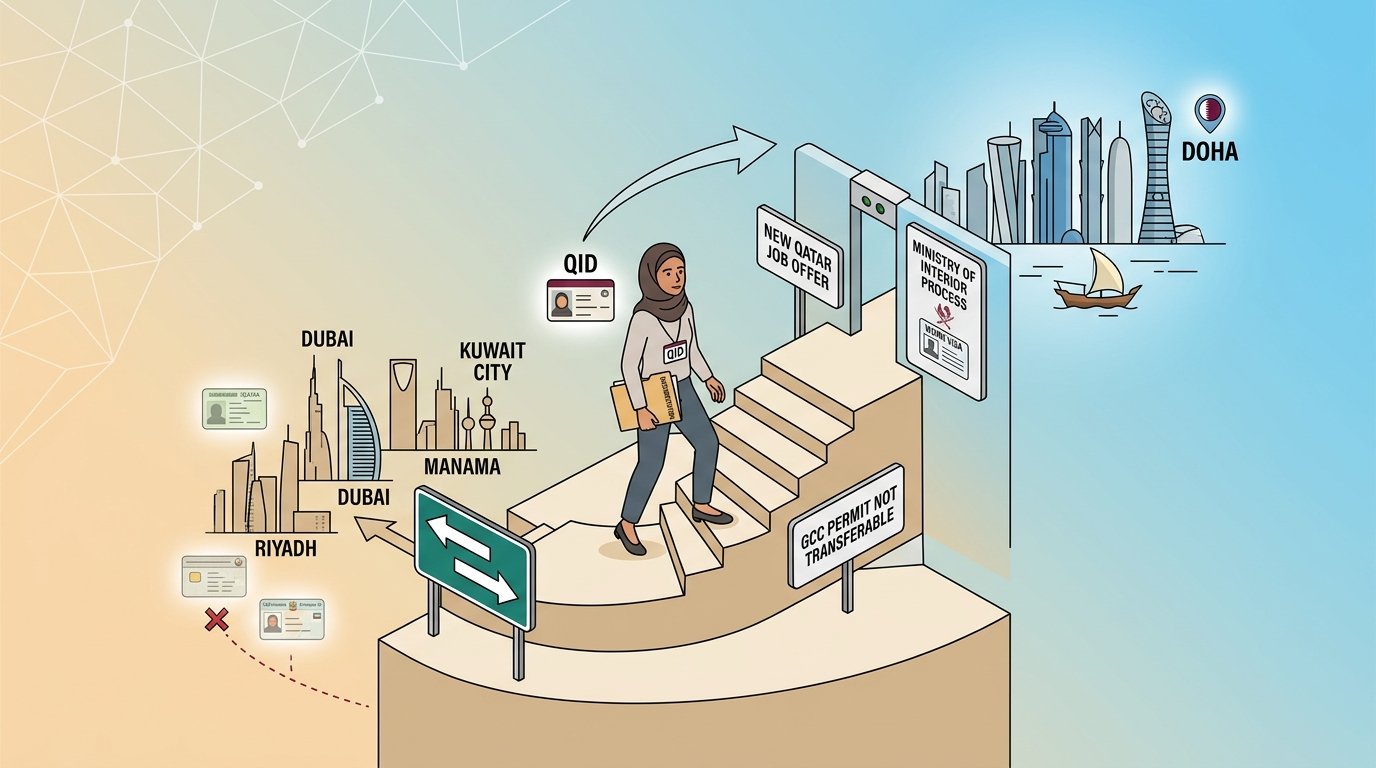
Every professional step in Qatar comes with some admin. The standard path is an employer-sponsored work visa that leads to a Qatar ID (QID) residence permit — typically valid for 1–2 years and renewable for as long as you're employed.
When you take a new role, expect the following:
- Passport valid for at least six months.
- Attested educational certificates — attestation via your home-country ministries and the Qatar embassy typically takes around 2–6 weeks, so start early.
- Medical check report and passport-sized photos.
- QID transfer or new issuance processed by your new employer once you've completed the switch.
One reassuring note on pay floors: Qatar's minimum wage framework guarantees a basic wage of QAR 1,000/month, plus QAR 500 housing and QAR 300 food allowances where these aren't provided in kind — an effective minimum of around QAR 1,800/month. Most professional expats sit far above this, but it's a useful benchmark when reviewing an offer.
A practical 5-year progression plan
- Year 1: Land the role, deliver reliably, and learn how your industry operates locally. Build your network from day one.
- Year 2: Add a certification relevant to your field and take on a project you can point to later.
- Year 3: Push for a mid-level title internally — or start exploring a strategic external move now that the NOC barrier is gone.
- Year 4: Move into a supervisory or specialist role. Aim for the QAR 11,000–15,000 band (higher in technical fields).
- Year 5: Position yourself for senior responsibility — lead a team, own a budget, and target the QAR 20,000+ tier.
None of this is guaranteed, but expats who treat their Qatar career deliberately — skills, results, network, well-timed moves — consistently reach senior roles faster than those who wait to be noticed.
FAQs
How long does it take an expat to reach a senior role in Qatar?
Most expats reach a genuine senior or management role after around seven years, though specialists in oil and gas, finance and healthcare can get there in six to eight years, and sometimes faster with the right qualifications and a well-timed job move.
Can I change jobs in Qatar without my employer's permission?
Yes. The old No Objection Certificate (NOC) requirement has been abolished, so expats can change employers without prior permission from their current sponsor, following the procedures overseen by the Ministry of Labour and the Ministry of Interior. Check your notice period and any sector-specific rules first, and confirm the current steps with your new employer before you resign.
What salary should I expect at each career stage?
As a rough guide in 2026: entry-level professional roles pay typically around QAR 7,000–10,000/month, mid-level around QAR 11,000–15,000, and senior roles start around QAR 20,000–30,000 — rising to QAR 25,000–45,000 in high-demand sectors.
Which sectors offer the fastest career progression?
Oil and gas, finance and banking, healthcare, aviation, and engineering and construction offer the strongest and fastest-paying tracks for expats, largely because they combine high demand with a shortage of specialised skills.
How long is a Qatar ID (QID) valid?
An expat QID is typically valid for one to two years and is renewable for as long as your employment continues. Your employer usually handles renewal and any transfer when you change roles.
Do I need to speak Arabic to progress in Qatar?
No — most expat professional roles operate in English. Arabic is a genuine advantage in client-facing, sales and government-adjacent roles, but it's rarely a barrier to progression.
Ready to make your next move? Browse the latest jobs in Qatar on Qatar Living and find the role that takes your career to the next stage.
Stay updated with the latest news, events, sports updates, business insights, real estate and lifestyle stories on Qatar Living — the leading online platform for residents, expats, and visitors in Qatar.
Follow Qatar Living for daily updates:
- Instagram - @qatarliving
- X - @qatarliving
- Facebook - Qatar Living
- YouTube - qatarlivingofficial
Up Next

Oil & Gas Careers in Qatar: Entry to Senior Roles
Oil & gas careers in Qatar: entry-level to senior salary ranges in QAR, top employers, benefits and how to apply. Your practical 2026 guide.
Jul 20,2026
Recruitment Agencies in Qatar 2026: Types & Fees
Recruitment agencies in Qatar 2026: how they work, real fees, agency types, and how expats and employers can use them the right way.
Jul 8,2026
Work Permit Processing Times Qatar: Timeline Guide
Work permit processing times in Qatar: the 4–8 week timeline, documents you'll need, and every step from signed offer to QID and residence permit.
Jul 6,2026
Jobs in Qatar 2026: How to Find Work Fast
Looking for jobs in Qatar? Our 2026 guide covers where to search, top sectors, salaries in QAR, visa basics and how to land a role in Doha fast.
Jun 11,2026